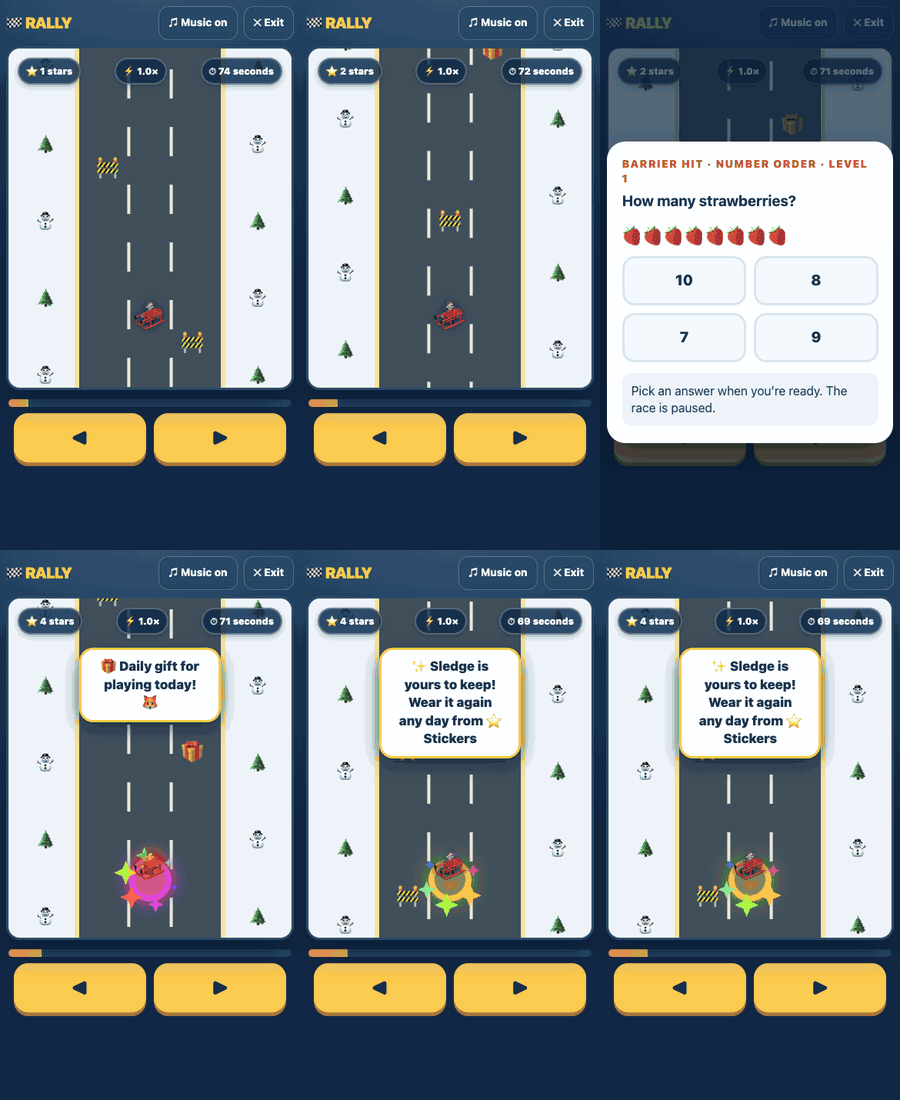
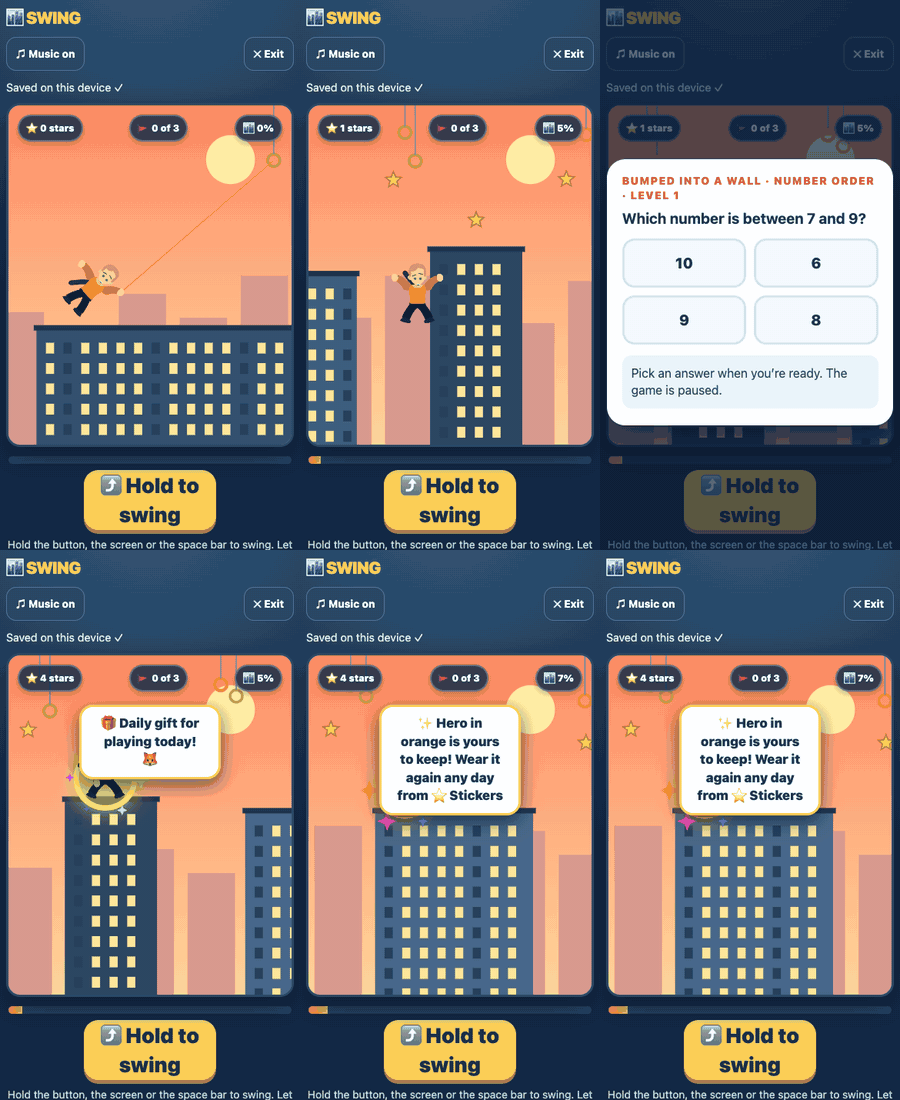
Your child is racing a car or kicking penalties. Every so often the game stops and asks a math question. That part
is easy to see. What you can't see is the part that decides which question comes next, and when. Here's what it
does, in plain words.
A question appears with two to four answers to tap. Right first time earns stars and a five-second power-up: the
character glows and bumps don't count. Right on the second go earns a smaller power-up. Then the game carries on.
The game is the reason to answer the next one. Nobody has to say "ten more minutes of math". They ask for one more
run, and every run has questions in it.
Rally: the race pauses for a question.Swing: same idea, different game.
When they get it wrong
A wrong answer never costs stars or progress. But it can't be skipped by tapping every button either. On a four-answer question:
First wrong try
"Not quite. Try again." For a sum, a picture of counters shows up to help.
Second wrong try
A clue card covers the question. Its Try again button wakes up after a second, so it gets read instead of tapped past.
Third wrong try
The game shows the answer and how it's worked out, step by step. Continue waits a second here too.
The point is that a slip turns into a small lesson, not a dead end. And it doesn't end there.
A missed question comes back, a bit easier
Any question that wasn't right first time comes back in the same session, about a minute later and after at least
three other questions. Long enough that your child has to remember it, not just copy what was on screen a second ago.
If the answer had to be shown, the game steps down first. The next few goes ask an easier question of the same kind.
Get that right and it steps back up toward the hard one. There are three easier questions at most per day, then
that idea rests until tomorrow, so a bad evening can't turn into the same question over and over.
Questions they know come back later, on purpose
This is the part most games leave out. We forget things on a curve: fast at first, then slower. The psychologist
Hermann Ebbinghaus described it in the 1880s, and research since then keeps finding the same thing. Practice spread
out over days tends to stick better than the same practice crammed into one sitting. Pulling an answer out of memory
also tends to build it more than reading it again.
So every question has its own schedule. We use FSRS, a free, open-source scheduler that the flashcard app Anki also
offers. It tries to bring each question back around the time your child would be about 90% likely to still
remember it. Right first time, and the next gap gets longer: days, then weeks. Missed, and it comes back sooner.
When a question's next gap reaches a month, your child gets a "Learned" star for it. It's the one sticker that
means "this is in long-term memory now".
What that means for you: ten minutes most days does more than an hour on Sunday. You don't have to
plan what to review. The game keeps track of every question and picks the ones that are due.
Harder when they're ready, easier when they're not
Each topic (adding, money, telling time and so on) has levels. Two right in a row at the current level and the
topic moves up one. Your child sees "Two correct! You're ready for a harder one." A miss drops it back one level.
Nobody picks a level from a menu: the game keeps your child working just past what's comfortable.
New ideas get shown before they get tested
Your child might meet an idea in the games before school has covered it. For ideas like odd and even, counting
coins, halves, tens and ones, or the months in order, the first three questions are a teaching version. They show
the idea on screen while they ask, for example a number drawn as pairs of dots for odd and even.
If the teaching version is missed three times in a row, the game takes that as "not ready yet". It parks the idea
for two weeks, then starts it again from the teaching version. A seven-year-old shouldn't spend the evening failing
at something nobody has taught them.
Rewards that pay for thinking, not tapping
Your reward, their targetSet a reward and a target, like a trip to the park for 30 answers right first time. Only first-try answers count, so tapping every button until one is right never moves the bar.
Stickers that unlock new looksRight-first-time answers unlock new characters and colors in each game. Early unlocks come quickly and later ones take longer.
Turning up counts, missing a day doesn't hurtA daily gift on the first answer of the day, a badge for playing 3 days in a week, and a sticker every 5th day played in a month. The days don't have to be in a row, and nothing is ever taken away.
What you see as a parent
With the Family Plan, the parent report shows days played, answers right first time, the topics going well, the
topics worth another look, and the latest slips. You can also snap a photo of tonight's worksheet: it becomes
practice questions on the same skill with new numbers. You check them first, and then they go through all the
steps above, like any other question.
Yes. Every question has two to four answers to tap, which works for young children who can't type yet. Getting it right on the first try is what counts toward stars, levels and rewards, so guessing doesn't pay.
How long should my child play?
Short and often works better than long and rare, because the schedule spreads questions over days. Ten minutes most days is a good start.
Does my child lose anything for a wrong answer?
No. A wrong try costs nothing. The question just comes back later, sometimes as an easier one first.
Can we try it before paying?
Yes. A few games are free with no account: type a first name, pick an animal and play.
See it for yourself
Play a round with your child tonight. Get one wrong on purpose and watch what happens.