Short answer: free and run by the government, U.S. Mint Coin Classroom. Free and adjustable down to one coin at a time, Math Mammoth. Free and best for giving change, Mr Nussbaum's Cash Out. Free and best for a child who likes a score, RoomRecess Coins for Candy. And if the money questions you actually need are the ones on tonight's worksheet, that is the gap the Power-Up Arcade Family Plan fills.
The coin games on the table are free forever and they are genuinely the best place to start.
Why coins are harder than the numbers in them
When a child who can add 25 and 10 in their head looks blank at a quarter and a dime, the problem is not arithmetic. It is that coins break a rule they have spent their whole life proving. Bigger means more. More cake, more blocks, more juice. Then along comes money, where the smallest coin in the jar beats the second-largest.
The numbers are worth knowing, because once you have seen them you stop being surprised. Using the U.S. Mint's published coin specifications, the dime measures 17.91 mm across and is worth 10¢. The nickel measures 21.21 mm and is worth 5¢. The penny sits between them at 19.05 mm and is worth 1¢, and the quarter is the biggest of the four at 24.26 mm. So the order by size runs dime, penny, nickel, quarter, and the order by value runs penny, nickel, dime, quarter. Only the quarter is in the same place on both lists.
There is a second thing going on underneath. Counting coins means skip counting in 1s, 5s, 10s and 25s, and switching between those counts mid-pile. Three of those four are counts your child has met at school. Counting in 25s is not, which is a good reason the quarter trips up children who are otherwise fine, and a good reason it belongs last rather than first.
When school actually teaches this
If your six-year-old cannot count a handful of change, nothing has gone wrong. In the Common Core math standards, money turns up in second grade. Standard 2.MD.C.8 asks children to “Solve word problems involving dollar bills, quarters, dimes, nickels, and pennies, using $ and ¢ symbols appropriately,” and gives the example “If you have 2 dimes and 3 pennies, how many cents do you have?” Look at the four first-grade Measurement and Data standards and money is not mentioned once. First grade does lengths, clocks to the half hour, and simple data.
Which tells you what the useful job is before second grade. Not counting totals. Naming the coins, telling them apart by feel, and knowing what each one is worth. Second grade assumes a child arrives with that, and a child who does find the word problems much easier than one meeting a nickel for the first time in a worksheet.
Three coin games for tonight, with the coins you already have
Empty the jar, keep a timer going, and pick one. Ten minutes each. These are the ones that have worked at our kitchen table, and the order is deliberate: the first builds the habit, the second teaches the idea most worksheets skip, the third is the one children ask to play again.
- Sort and Skip. Grab a fistful. Sort into four piles by coin, then count each pile out loud in its own number: the dimes in 10s, the nickels in 5s, the pennies in 1s, the quarters in 25s. Add the four totals at the end. The sorting is not busywork, it is the whole trick, because it turns one impossible mixed count into four easy ones.
- Make It Another Way. You say an amount, say 30¢. They build it from coins. Then they have to build the same amount a second way, and a third if there is one. This is the bit worksheets rarely drill and the bit shops demand. Start at 10¢ and 15¢, and say so when an amount has only one answer, because spotting that is also the skill.
- Shop the Kitchen. Price five things with sticky notes, everything under 50¢. They buy two and pay exactly. Then switch roles: you hand over a dollar, they work out your change and count it back into your hand. Counting the change back out loud is a great deal easier than doing the subtraction on paper.
Two rules that make all three worth more. Count only the first answer they give, so guessing until something lands does not pay. And stop when the timer goes, even mid-pile. Finishing on time is the reward, and a child who knows the end exists tries harder inside it.
Four free online money games, and what each one is for
All four are free, and all four were checked on 10 October 2026. They do quite different jobs, so the useful question is not which one is best. It is which one matches the bit your child is stuck on.
1. U.S. Mint Coin Classroom: free, no ads, and it is the Mint
kids.usmint.gov is the United States Mint's own children's site, and its games page says “Play free educational games online and learn more about coins! These fun kids games can be played for individual enrichment or as part of a lesson plan.” Two of them are exactly on topic: Counting With Coins and Making Change. Alongside those sit Coin Memory Match, which is a good way to drill coin names before any counting starts, and Plinky's Piggy Bank Party. The site also carries coin activities, coloring pages and lesson plans you can browse by grade.
Why it leads the list: it is a government site, so there is no membership, no advertising and nothing to buy at any point. For a seven-year-old who wants a few minutes on a tablet, that is a rare thing. The flip side is that it is a coin education site rather than a practice engine, so there is no adjustable difficulty and no record of what your child got right.
2. Math Mammoth Counting Money: free, and the one you can tune to a single coin
Math Mammoth's counting money game is billed as “Online practice for K-3rd grade” and it does the thing the others cannot: you choose which coins and bills appear, the maximum total, how many coins can be on screen, and whether you want 5, 10, 15 or 20 questions. Tick only the dime and the penny and that is all your child will see.
Their page also carries the single best piece of teaching advice I have read on the subject, and they give the reason with it. Children starting out “could first count ONLY dimes and pennies, as these correspond to tens and ones and are thus the easiest to count. Then they could advance to counting dimes, nickels, and pennies. Next they could practice counting ONLY quarters, then perhaps quarters and dimes.” Follow that order and the whole topic stops being one wall and becomes four steps. There are sister games for the Making Change and shopping stages too.
3. Mr Nussbaum's Cash Out: free, and the best one for giving change
Cash Out puts your child behind a till. Its own page describes it as a game where “Students have three minutes (or can play without a timer) to complete as many sales as possible by giving customers the correct change,” and says it is “totally customizable and with different skill levels and hints/no hints,” with American coins or Euros. The same site has Coin Search, Money Tree and Garage Sale Wizard, and printable versions of Cash Out if you would rather have it on paper.
Worth knowing before you open it: the site is ad-supported and sells an optional subscription to teachers, so your child will see advertising around the game. The timer is also the point of the game, which suits a child who enjoys pressure and is the wrong medicine for one who freezes under it. There is a no-timer option, and for an anxious child I would use it.
4. RoomRecess Coins for Candy: free, and it tells you how they did
Coins for Candy has your child buy a sweet by putting the right coins on the desk. Its page says “students can pick from three levels and practice using coins such as pennies, nickels, dimes, and quarters,” and that “Teachers can keep track of student progress with counting money because we calculate children's accuracy and display a grade.” That last part is unusual among the free ones and makes it the pick if you want to know whether ten minutes actually landed. RoomRecess also has printable counting coins worksheets next to it.
5. Power-Up Arcade Family Plan: what about the money questions on tonight's worksheet?
Think about what the four above have in common. They practice money in general. None of them practices the page in your child's backpack, the one with four red marks on it. So you either hunt a skill tree for something that looks close, or you invent questions yourself at half past seven in the evening.
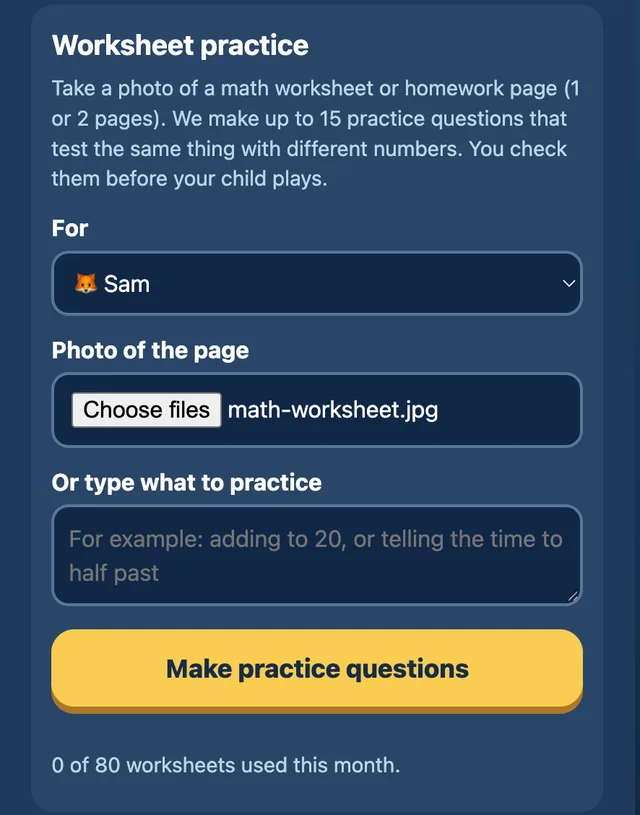
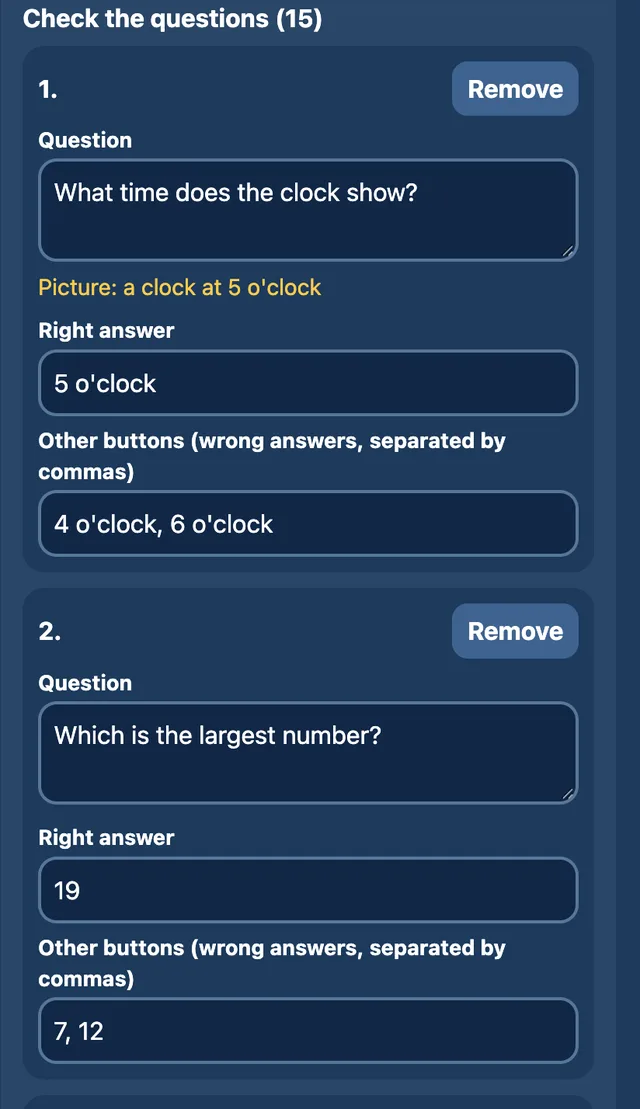
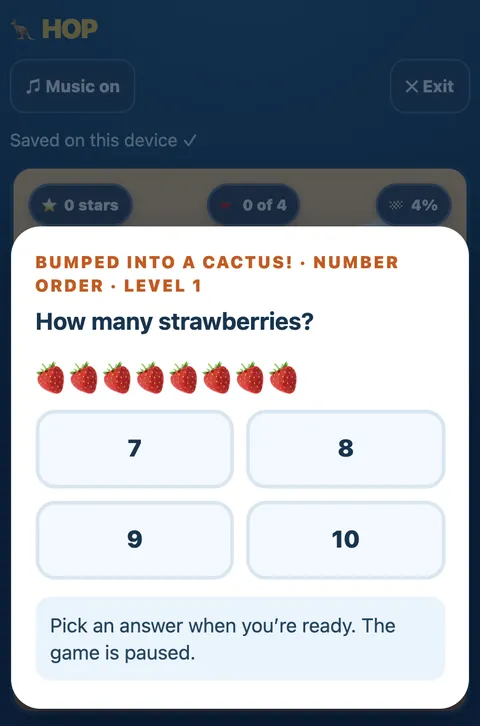
The Arcade's math games work the other way round. You photograph the worksheet and about a minute later you get up to 15 twin questions: the same skill with different numbers, so the homework answers are never handed over. You read every question and can edit or bin any of them before your child sees it, and the photo is deleted as soon as it has been read. Then they play one of 17 games, racing or swinging or kicking penalties, and the questions arrive inside the game.
On money specifically, so you know what you are getting: 59 of the 1,260 questions in the Family Plan are money questions, from coin sums like 6¢ + 3¢ up to shop problems with two prices in them. Five of those are in the free sample your child can play on the device with no account at all, which is enough to see whether the format suits them.
What it is not: a curriculum, and not a replacement for school. No reading, no science, no lesson videos, no teacher. If you want a graded scheme that walks a child through every money skill in the year, a full curriculum does that and this does not. What this does is the ten minutes after homework, on the thing they got wrong today.
Try the games before you decide anything
17 games for kindergarten to 6th grade, ages 5 to 12. Trying a few needs no account: type a first name, pick an animal, go. The Family Plan adds worksheet photos, all 1,260 questions on every device, up to 6 players and a parent report.
Try a few games free, no account needed. Family Plan: 7 days free on your first plan, then $9.99 a month or $99 a year. Cancel anytime from Manage payments.
How worksheet photos work →The five at a glance
| Game | Ages / grades | Cost (checked 10 Oct 2026) | Best at |
|---|---|---|---|
| U.S. Mint Coin Classroom | Activities browsable by grade | Free, no ads, government site | Coin names, counting, making change |
| Math Mammoth Counting Money | K–3rd grade | Free in the browser | Practicing one coin at a time |
| Mr Nussbaum Cash Out | Not stated; change and decimals | Free, ad-supported | Giving change against the clock |
| RoomRecess Coins for Candy | Elementary, three levels | Free | Practice that reports an accuracy grade |
| Power-Up Arcade (ours) | K–6th grade, ages 5–12 | A few games free with no account; Family Plan $9.99/mo or $99/yr after a 7-day trial | The money questions on tonight's worksheet |
Every claim above is quoted from that site on 10 October 2026. Free tools change their terms, so check before you hand over a tablet.
The order to teach it in
Most money trouble is really sequencing trouble. A child gets handed a mixed pile in week one and never gets a clean run at any single coin. Borrowing Math Mammoth's sequence and adding the table games, a four-week version looks like this.
Week one, dimes and pennies only. Nothing else in the jar. This pair is tens and ones wearing hats, so your child is counting something they already know how to count. Play Sort and Skip with just those two.
Week two, add nickels. Now the counting switches between 10s, 5s and 1s, which is the real new skill. Keep the totals small and count out loud together.
Week three, quarters on their own. Just quarters, counting 25, 50, 75, a dollar. Treat it as its own thing rather than a fifth coin in a pile, because counting in 25s is new and deserves the room.
Week four, mix and shop. Everything in, and move to Make It Another Way and Shop the Kitchen, because equivalence and change are what money is actually for.
One note on how long each sitting should be. Psychologists have described the forgetting curve since Hermann Ebbinghaus's work in the 1880s, and the broad finding, usually called the spacing effect, is that practice spread across several days tends to be remembered better than the same practice crammed into one sitting. Four ten-minute goes across a week beat one long Sunday, and ten minutes is a far easier thing to get a child to agree to.
Frequently asked questions
What age do children learn to count money?
Second grade, in the Common Core standards. Standard 2.MD.C.8 covers word problems with dollar bills, quarters, dimes, nickels and pennies, using $ and ¢ correctly. None of the four first-grade Measurement and Data standards mention money at all, so a six-year-old who cannot count change is not behind. Handling real coins before then still helps, because naming and sorting them is what second grade assumes you arrive with.
What is the best free counting money game?
The U.S. Mint's Coin Classroom, for Counting With Coins and Making Change, because it is free, ad-free and made by the people who make the coins. If you want practice you can narrow to one coin at a time, Math Mammoth's free game lets you pick exactly which coins appear and how high the total goes.
Why does my child mix up the nickel and the dime?
Because the dime is smaller. On the Mint's own figures the dime is 17.91 mm across and worth 10¢, while the nickel is 21.21 mm and worth 5¢. Your child is applying a rule that holds true for almost everything else they have ever counted. Say it out loud to them, as a quirk of the coins rather than a mistake of theirs, and it tends to stick within a week.
Should I use real coins or an app?
Real coins first, for the sorting and naming, because weight and size are information a screen cannot give. Then an app for volume, since nobody wants to invent forty questions by hand. The two are not rivals: ten minutes with the jar on a Monday and ten minutes on a tablet on a Tuesday is a better week than either twice.
My child can count coins but cannot give change. What now?
Counting up, out loud, with the coins in their hand. From 68¢ to a dollar you say “68, 70, 80, 90, a dollar,” laying down two pennies then three dimes. It is addition rather than subtraction, which is why it often works when the paper method does not. Cash Out and the Mint's Making Change both drill exactly this.
Do your games have money questions in them?
Yes. 59 of the 1,260 questions in the Family Plan are money questions, from coin sums up to shop problems with two prices. Five are in the free sample that plays on the device without an account. You can also photograph a money worksheet from school and get up to 15 twin questions from it, which you check and can edit or remove before your child plays.