Short answer: free, structured and it keeps a report, XtraMath. Free and the best at breaking the counting habit, the Math Trainer at Math is Fun. Free, ad-free and the only one you can narrow to six facts, Math Mammoth. Free with ads and the best for a child who wants a certificate, Timestables.com. And if the facts you need practiced are the ones marked wrong on tonight's worksheet, that is the gap the Power-Up Arcade Family Plan fills.
And the ten-minute routine in the yellow box costs nothing at all, works with a pencil, and is the part I would not skip.
What "knowing your facts" actually means
It is worth being precise, because "fluent" gets used loosely and the standards are not loose at all. In the Common Core math standards there are two deadlines. Standard 2.OA.B.2 asks children to “Fluently add and subtract within 20 using mental strategies,” then adds the sentence that matters: “By end of Grade 2, know from memory all sums of two one-digit numbers.” Standard 3.OA.C.7 does the same job a year later for times tables. “Fluently multiply and divide within 100,” and “By the end of Grade 3, know from memory all products of two one-digit numbers.”
Know from memory. Not work it out quickly, not get there reliably. That single phrase is the gap between a child who is doing fine on a worksheet and a child who is doing fine in fourth grade, where long multiplication and fractions assume the small facts cost nothing. A child still rebuilding 7 × 8 in the middle of a long division problem has a head full of 7 × 8 and no room left for the long division.
Which also tells you what to stop worrying about. A six-year-old counting on fingers is on schedule. A nine-year-old who still counts up to 13 is not behind in any dramatic sense either, they just have not had enough practice at the retrieving part, and that is fixable in a few weeks of ten minutes.
Why the usual fact practice does not stick
Three things go wrong at kitchen tables, and all three are fixable without buying anything.
The set is too big. Hand a child the full multiplication grid and nothing visibly improves from one day to the next, which is the fastest way to lose them. Six facts a week improves visibly on Wednesday.
Counting is never beaten. If a child has as long as they like, counting always gets there, so recall never has to. The Math Trainer at Math is Fun states its whole method in four words, “Train yourself to remember, don't count,” and backs it with a cutoff timer and the advice to “Choose 4 seconds for best effect.” Four seconds is not a cruelty. It is just short enough that counting loses, which is the only condition under which a child's brain bothers to switch methods.
The practice shows rather than asks. Reading a times table, chanting it, sticking it on the fridge: all of that is restudying. Retrieval is the part that builds the memory. In a well-known 2006 study in Psychological Science, Henry Roediger and Jeffrey Karpicke found that students who were tested on material remembered substantially more of it days later than students who restudied the same material for the same length of time, even though the restudying group did better on an immediate test. The finding is about prose rather than times tables, so take it as a principle rather than a promise. But the principle points one way. Ask for the answer. Do not show it and hope.
There is a fourth thing, about timing rather than method. Psychologists have described the forgetting curve since Hermann Ebbinghaus's work in the 1880s, and the broad finding, usually called the spacing effect, is that practice spread across several days tends to be remembered better than the same amount crammed into one sitting. Which is why ten minutes is plenty for every tool below. Four short goes across a week beat one long Sunday, and ten minutes is a far easier ask at half past seven in the evening.
The 10-minute fact ladder, for tonight
No app needed. An index card, a pencil and a timer on the stove. This is the routine that has worked at our table, and the shape of it is the point: a tiny set, a hard cutoff, and one visible number that goes up.
- Pick six facts, not sixty. Look at the last marked worksheet and take the six your child actually got wrong or slow. Write them on one index card, answers on the back. Six is the whole week's work. If there are no marked worksheets, start with doubles for addition, or the 3s and 4s for multiplication.
- Two minutes: the four-second rule. You read a fact, they answer. If the answer has not arrived in about four seconds, you say it, they repeat it, and the card goes to the back of the pile. No working out, no fingers, no shame about either. You are training the gap to close, not testing them.
- Three minutes: the two-pile sort. Go through the six again and sort them as they answer: instant in the left pile, slow or wrong in the right. Count the left pile out loud and write that number on the card with today's date. That number is the entire reward system and it works better than praise, because it is theirs and it is real.
- Three minutes: the right pile only. Just the slow ones, three or four times each, with whatever trick fits. Nine is ten minus one. Doubles plus one is a double you know and a step. Four times something is double it, double it again. A fact with a reason attached is recalled sooner than a fact with nothing attached.
- Two minutes: mixed, and finish up. All six, shuffled, no warning. Then stop, even if they are on a roll and asking for more. Stopping while they still want another go is what makes tomorrow easy. Retire a fact once it has been instant three days in a row, and put a new one on the card.
Two rules that make the whole thing worth more. Count only the first answer they give, so guessing until something lands does not pay. And keep the cards. Four weeks of rising numbers on the back of an index card is the most convincing thing a struggling child will see all month.
Four free math fact practice tools, and what each one is for
All four are free to use and all four were checked on 12 October 2026. They do different jobs, so the useful question is not which is best overall. It is which one matches the bit your child is stuck on.
1. XtraMath: free, structured, and it tells you what happened
XtraMath is the one I would start with if you want a daily program rather than a game. Its own homepage says it was “Founded as a 501(c)3 non-profit in 2009” and sells the commitment as “Build Essential Math Skills in Just 10 Minutes a Day, for Free.” It covers “addition, subtraction, multiplication, division, and multiple custom programs,” and it keeps going through the four operations in order rather than letting a child graze.
On cost, their pricing page lists a Standard plan at $0, described as “free forever” and “A great way to explore XtraMath with no cost or commitment,” with automated reports included. Family Pro is listed at $6 a year and adds three children, unlimited student programs and priority support. Six dollars a year is not a hard decision, and the free plan is genuinely usable before you make it.
The honest downside: it looks like homework. There is no race, no character, no reason for a reluctant child to ask for it. For a child who will sit down because you asked them to, that plainness is a feature. For a child who negotiates, it is the whole problem.
2. Math Trainer at Math is Fun: free, and the best at breaking the counting habit
The Math Trainer is a plain page that does one thing extremely well. It says it “Responds to your answers, so it trains your weaknesses” and “Remembers your performance so it gives you more practice on your weaknesses,” it shows the correct answer when a child gets one wrong, and it runs on a cutoff time you set, with the recommendation to “Choose 4 seconds for best effect.” There are versions for addition, subtraction, multiplication and division.
Its own advice on dose is the shortest of any tool here: “You can make good progress by having 3 sessions of 5 minutes every day.” Fifteen minutes total, in three pieces, which is the spacing effect written as a schedule.
Use it when your child clearly knows the facts but is still counting out of habit, because the cutoff is the only thing on this page that directly attacks that. Do not use it with a child who panics at a timer. There is nothing to be gained from making four seconds into a stressful event, and plenty to lose.
3. Math Mammoth practice: free, ad-free, and the only one you can narrow to six facts
Math Mammoth's practice section describes itself as “Ad-free Online Practice for Math Topics (grades K-8),” and it is the one that matches the fact-ladder routine above most closely, because you choose exactly which facts appear.
On the multiplication page you can practice “any combination of the multiplication tables,” restrict it further with “Use only the following numbers,” set the number of questions anywhere from 5 to 70, and choose “Timed practice” at 5, 10 or 15 seconds per answer, “Not timed,” or practice for a set number of minutes. The page says it is “very helpful for students in elementary and middle school.” The single-digit addition page is organized by exactly the groups a teacher would use: “Doubles,” “Doubles + 1,” the “9 Trick,” the “8 Trick,” with zero, and missing addends like “2 + ___ = 8.” There are matching division and fact-family pages too.
So this is the pick for week three, when you know the problem is the 7s and the 8s and you want twenty questions about nothing else. What it does not have is any memory of your child between sessions. You run it, you watch, you note it yourself.
4. Timestables.com: free with ads, and the one with a certificate at the end
Timestables.com is multiplication only, and it is built as a path rather than a drill. It runs a five-step plan per table, from reading the table through filling in answers in order, dragging answers into place, and mixed questions, ending at step five: “Proof your knowledge and get the diploma.” There is a speed test where you pick the tables, a one-minute test, printable worksheets, and games including a multiplayer speed quiz.
The diploma is the reason it is on this list. A “little” diploma covers 30 questions on the 1, 2, 3, 4, 5 and 10 tables, and a “big” one covers 40 questions on the tables from 1 to 12. For a child who is motivated by a finish line and a printable certificate, that structure does something no amount of parental encouragement does. Worth knowing before you hand over a tablet: the site carries advertising, and it only does multiplication.
5. Power-Up Arcade Family Plan: what about the facts on tonight's worksheet?
Think about what the four above have in common. They practice math facts in general, from their own lists. None of them practices the page in your child's backpack, the one with four red marks on it. So you either hunt a skill tree for something that looks close, or you invent questions yourself while dinner is going cold.
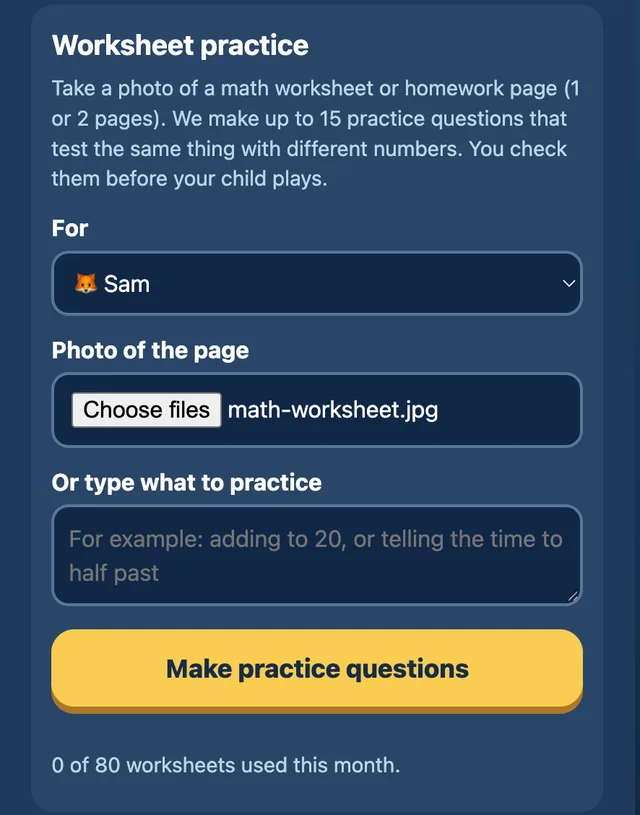
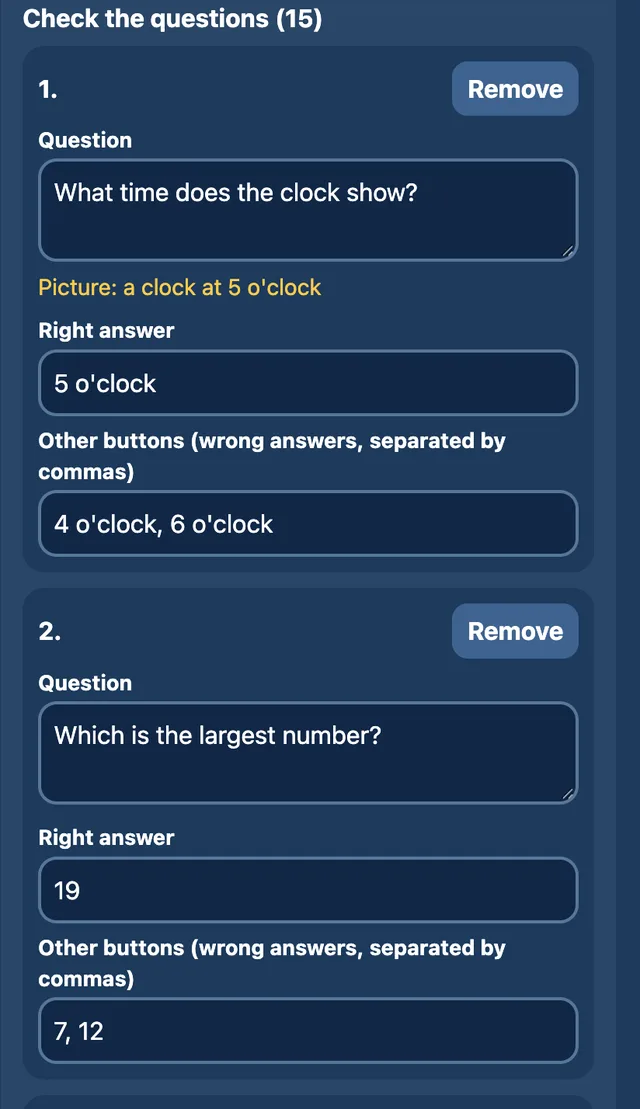
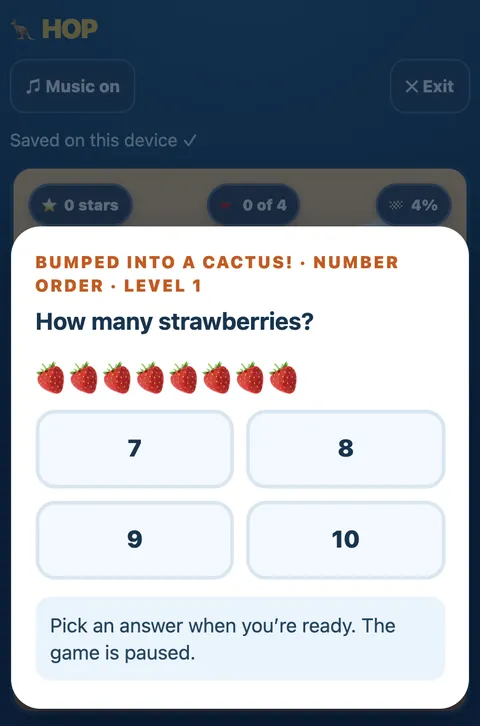
The Arcade's math games work the other way round. You photograph the worksheet and about a minute later you get up to 15 twin questions: the same skill with different numbers, so the homework answers are never handed over. You read every question and can edit or bin any of them before your child sees it, and the photo is deleted as soon as it has been read. Then they play one of 17 games, racing or swinging or kicking penalties, and the questions arrive inside the game, at the moment they are already paying attention.
The piece that matters most for fact practice is the goal bar. You set a reward and a target for each child, counted in answers they get right on the first try, and it shows as a five-stage bar inside every game. First try is the whole point, for the same reason the fact ladder counts only the first answer: a target that rewards guessing teaches guessing. Results download as a CSV per child, so a month of first-try accuracy is something you can actually look at.
What it is not: a curriculum, and not a replacement for school. No reading, no science, no lesson videos, no teacher. If you want a graded scheme that walks a child through every skill in the year, a full curriculum does that and this does not. What this does is the ten minutes after homework, on the facts they got wrong today.
Try the games before you decide anything
17 games for kindergarten to 6th grade, ages 5 to 12. Trying a few needs no account: type a first name, pick an animal, go. The Family Plan adds worksheet photos, all 1,260 questions on every device, up to 6 players and a parent report.
Try a few games free, no account needed. Family Plan: 7 days free on your first plan, then $9.99 a month or $99 a year. Cancel anytime from Manage payments.
How worksheet photos work →The five at a glance
| Tool | Facts covered | Cost (checked 12 Oct 2026) | Best at |
|---|---|---|---|
| XtraMath | Add, subtract, multiply, divide + custom programs | Standard plan $0 “free forever”; Family Pro $6/yr for 3 children | A structured 10-minute daily program with a report |
| Math Trainer (Math is Fun) | Add, subtract, multiply, divide | Free in the browser | Breaking the counting habit with a 4-second cutoff |
| Math Mammoth practice | K–8; pick exact tables and fact groups | Free, and the section says ad-free | Narrowing practice to the six facts that are shaky |
| Timestables.com | Multiplication only, tables 1–12 | Free, ad-supported | A child who wants a finish line and a diploma |
| Power-Up Arcade (ours) | K–6th grade, ages 5–12, plus your own worksheets | A few games free with no account; Family Plan $9.99/mo or $99/yr after a 7-day trial | The facts marked wrong on tonight's worksheet |
Every claim above is quoted from that site on 12 October 2026. Free tools change their terms, so check before you hand over a tablet.
The order to practice the facts in
Most fact trouble is sequencing trouble. A child meets the whole grid in week one, never gets a clean run at any single group, and concludes they are bad at math. Taking the groups Math Mammoth's own practice pages are built around, here is the order I would use.
Addition, in five groups. Doubles first, because they are the easiest to hear and the most useful later. Then adding one and two, which is really counting on and most children have it already. Then the pairs that make ten, which is the single highest-value group in the whole of addition. Then the near-doubles, where 7 + 8 becomes a double you know plus a step. Then the nine trick and the eight trick, where you add ten and take one back. Five weeks, six facts a week, and addition is done.
Subtraction, as the same facts backwards. Do not treat it as a new set. Practice it as fact families: 6 + 7, 7 + 6, 13 − 6, 13 − 7, all on one card. Math Mammoth has a fact families page for exactly this, and it halves the work because there was never a second set of facts to learn.
Multiplication, easiest patterns first. The 2s, 5s and 10s, which are skip counts your child already knows. Then the squares, 3 × 3 up to 9 × 9, because they are oddly memorable and they anchor everything near them. Then the 3s and 4s, where four times something is double it and double it again. The 6s, 7s and 8s last, because they have the fewest patterns to lean on and deserve a child who has already had four weeks of winning.
Division, with multiplication, never alone. Same fact-family trick: 6 × 7, 42 ÷ 6, 42 ÷ 7 on one card. A child who knows their times tables and still cannot divide has usually never been shown that it is the same card turned over.
One note on the whole plan. Retire a fact when it has been instant three days in a row, not the first time it comes out right, and put the retired cards in a pile your child can see getting fatter. If you want the same idea applied to the rest of homework instead of just the facts, that is what turning math homework into practice games is about.
Frequently asked questions
What are math facts, and when is a child supposed to know them?
They are the single-digit sums, differences, products and quotients a child answers without working them out. Common Core standard 2.OA.B.2 asks children to “Fluently add and subtract within 20 using mental strategies” and adds that “By end of Grade 2, know from memory all sums of two one-digit numbers.” Standard 3.OA.C.7 asks them to “Fluently multiply and divide within 100” and adds that “By the end of Grade 3, know from memory all products of two one-digit numbers.” Both say know from memory rather than work out quickly, which is the part most home practice misses.
How long should math fact practice be each day?
Ten minutes, then stop. XtraMath sells the idea as “Build Essential Math Skills in Just 10 Minutes a Day, for Free,” and the Math Trainer suggests something shorter still: “You can make good progress by having 3 sessions of 5 minutes every day.” The spacing effect, studied since Ebbinghaus's work on the forgetting curve in the 1880s, is the reason: practice spread across several days tends to be remembered better than the same amount crammed into one sitting.
What is the best free math fact practice program?
XtraMath, if you want a structured daily program with a report. It is a 501(c)3 nonprofit founded in 2009 and its Standard plan is listed at $0, free forever, across all four operations. If you want to narrow practice to the exact facts your child is shaky on, Math Mammoth's free pages are better, because you pick which tables appear and whether each answer is timed at 5, 10 or 15 seconds. Plans and prices checked 12 October 2026.
Should math fact practice be timed?
Timing is the right tool for a child who can recall and still counts out of habit, and the wrong tool for a child who freezes. The Math Trainer puts the logic plainly: “Train yourself to remember, don't count,” and “Choose 4 seconds for best effect.” A cutoff short enough to beat counting is what pushes a child toward recall. If it produces tears instead, turn it off. Math Mammoth has a “Not timed” option and nothing is lost by using it for a few weeks.
In what order should my child practice the facts?
Smallest groups first, never the whole table. Addition: doubles, then adding one or two, then the pairs that make ten, then near-doubles, then the nine and eight tricks. Multiplication: the 2s, 5s and 10s, then the squares, then the 3s and 4s, with the 6s, 7s and 8s last. Subtraction and division come free if you practice them as fact families alongside the sums and products they reverse.
Why does my child count on their fingers when they already know the answer?
Because counting works and has never let them down. Recall only replaces counting when recall is faster, so the thing that moves a child off their fingers is practice at retrieving an answer rather than rebuilding it. Retrieval is the active ingredient: in a well-known 2006 study in Psychological Science, Roediger and Karpicke found students who were tested on material remembered substantially more of it days later than students who restudied it for the same length of time. Fingers are not a habit to scold out of a child. They are a sign the recall is not fast enough yet.
Do your games practice math facts?
Yes, and around the facts on the page in your child's backpack rather than a generic list. You photograph tonight's worksheet and get up to 15 twin questions from it, the same skill with different numbers, so the homework answers are never handed over. You check every question and can edit or remove any of them first, and the photo is deleted once read. Then the questions arrive inside one of 17 math games. A few games are free with no account, which is a sample of 87 questions on the device.