Short answer: for number facts, XtraMath, free and nonprofit. For a child who wants a world to explore, Prodigy Math, whose questions are free. For a five or six-year-old, Khan Academy Kids, free with no ads. For practice on the worksheet that came home this week, our Power-Up Arcade: photograph the page and it makes questions that test the same thing with different numbers, inside the games. Coolmath Games calls its own games logic, strategy and decision-making. Worth knowing before you count an hour there as math practice.
Educational is a marketing word, not a standard
The label is the cheapest part of any of these products, which is why it sits on programs that drill number facts and on games where a child spends longer decorating a pet than answering anything. Judge the screen instead. Two games carrying the same word on the listing can be doing completely different jobs, and ten minutes with one of them is worth a fortnight of the other.
The one claim that sounds more official is an evidence badge. XtraMath's home page, for example, carries
an “ESSA Tier IV Certified” line. The four tiers in that system run from strong evidence at
the top down to a rationale at the bottom. The California Department of
Education sets out the bottom one in plain words: “Tier 4 – Demonstrates a Rationale: practices that
have a well-defined logic model or theory of action, are supported by research, and have some effort
underway by an SEA, LEA, or outside research organization to determine their effectiveness.” Read
that and you have a sensible theory with a study in progress, not a result. The same page notes that
federal school improvement money under “Title I, Section 1003” can only fund
“strong, moderate, or promising evidence (Tiers 1–3)”. That tells you how the system
itself ranks tier four.
cde.ca.gov, evidence-based interventions under ESSA
A tier still beats nothing, and XtraMath is, to my mind, the most useful free thing on this list. Just do not read a badge as proof and skip looking at the product yourself.
The test that sorts them: count the answers
Watch a child play almost any math app and you will see the same ratio problem. Something has to be collected, dressed, fed or raced, and in between those things a question appears. The teaching lives in the question. Everything else is the reason your child is willing to sit there, which matters, but it is overhead.
There is decent research behind that, and it is not complicated. In a 2013 review in Psychological Science in the Public Interest, John Dunlosky and colleagues assessed ten common study techniques and reported that “Practice testing and distributed practice received high utility assessments because they benefit learners of different ages and abilities and have been shown to boost students’ performance across many criterion tasks and even in educational contexts.” The techniques that lost were the comfortable ones: “Five techniques received a low utility assessment: summarization, highlighting, the keyword mnemonic, imagery use for text learning, and rereading.” That review looked at students of many ages and at studying rather than at math games, so treat it as a principle and not a promise. It still settles the question in front of you, because being asked something and finding out whether you got it right is the high-utility one, and watching is not.
The three-minute test, for the next game they open
Works on any app, any site, any grade, and it costs you one round of something you were going to let them play anyway. Sit beside your child, start a timer for three minutes, and count.
- Count the answers, not the taps. An answer means your child had to work something out and say or press a result. Choosing a hat is not an answer. Fewer than ten in three minutes and you have entertainment with numbers on it, which is fine on a Sunday and is not practice.
- Check they find out straight away. Right or wrong has to land within a second or two. A game that saves the feedback for a score screen at the end has let your child rehearse a wrong answer ten times first.
- Watch what happens after a mistake. The good ones bring that question back later in the session, and again another day. If a miss just vanishes, the game is measuring your child rather than teaching them.
- Ask who picked the level. If the game chose, can you override it? A child parked two grades below where they are will enjoy it and learn nothing, and that is the most common failure I see.
- Time the reward. Stopwatch the gap between questions. Forty seconds of animation for one sum is a ratio no amount of enthusiasm fixes.
Then stop and ask your child one thing: what were you practising? A child who can tell you was practising. A child who looks blank was playing, and sometimes that is exactly what you wanted.
Five educational math games, checked against that test
These are not competing for the same job. One drills facts, one gives a reluctant child a reason to come back, one teaches a five-year-old broadly, one is a thinking site that gets mistaken for math practice, and one is the Power-Up Arcade.
1. XtraMath: the one built for the thing most children need
If what your child needs is number facts, start here and stop reading. Its own headline is “XtraMath is the Proven Way to Develop Math Fact Fluency”, it was “Founded as a 501(c)3 non-profit in 2009”, and it offers to “Build Essential Math Skills in Just 10 Minutes a Day, for Free.” A program built only for fact fluency has nowhere to hide on the three-minute test, which is rather the point of it.
The honest caution is the same thing that makes it effective. Its reports track “accuracy, speed,
and fluency level for every operation”. Speed is the part that lands badly on a child who is still
working every answer out. Use it once the strategies are there, not while your child is still counting on
fingers.
xtramath.org
2. Prodigy Math: free questions wrapped in a world
Prodigy Math is pitched at “Grades 1 to 8. Aligned to your curriculum. Free math and English educational content,” and its FAQ is clear about what free covers: “Prodigy Math’s educational content (questions, in-game videos and math manipulatives) is free. Anyone can make a Prodigy Math account and start learning!” Questions arrive inside fights: “Answer math questions to win battles and make your mark on the Prodigy world.” That is a real answer to the hardest problem in this whole area, a child who will not sit down.
Two things to know before you start it. The ratio of battle to question is where it loses marks on the
test, so run the timer yourself rather than taking my word for it. And there is an optional paid
Membership, which adds “Goals and Rewards” and “premium features like worksheets, video
lessons and extra reports”. Decide what you will say about that before your child asks, not in the
middle of a session.
prodigygame.com, Prodigy Math
3. Khan Academy Kids: the best free start for a young child
For a four, five or six-year-old this is the one I would put on a tablet first. It is built “for kids ages two to eight,” the page says “100% free - forever” with “No ads, no subscriptions,” and it covers early literacy and language alongside math rather than math alone.
Its limit is the age range. A confident second grader can outgrow the math while still enjoying the
characters. Children also “follow a personalized path that grows with them”. I have never
found a way to aim it at one weak skill for a fortnight. Schools
pay separately, “For $5 per student,” for a teacher dashboard. A family pays nothing.
khanacademy.org/kids
4. Coolmath Games: good for thinking, not for times tables
This one is on the list because of what its name does to parents. Coolmath Games has been “the premier destination for fun + learning games since 1997,” and its about page describes what it licenses honestly: games that “always have a generous sprinkling of logic, strategy, and decision-making.” Logic and strategy are worth your child’s time. I would not count an hour there as arithmetic practice, and I would not expect it to move a fact-fluency problem.
The company says as much itself by pointing younger children somewhere else: “For our under 13 users,
Coolmath4Kids is an amusement park of math, games, and more, designed to teach math and make it
fun!” If your child is in elementary school and you want actual math from this family of sites, that
is the address to use.
coolmathgames.com, about us
5. The Power-Up Arcade
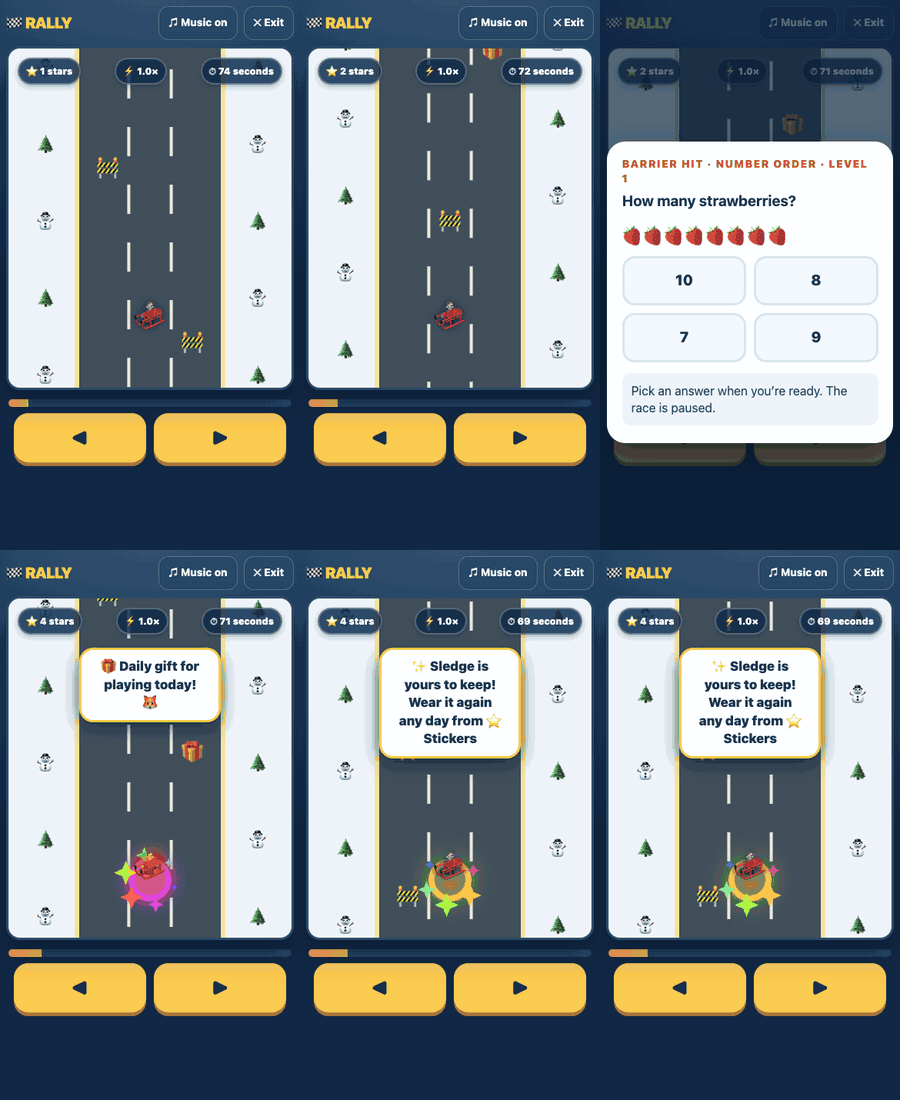
Your child picks a game from a menu that reads “Drive a monster truck, dodge barriers”, “Swing across the city rooftops”, “Beat the keeper, score goals”. There are 17 games on the menu, and the design decision that matters for the test above is this one: “All the games share each player’s practice, so questions come back when they’re due in any of them.” A fact missed in the racing game comes back in the penalty game. Spreading practice out rather than massing it is the second half of that high-utility pair in the Dunlosky review.
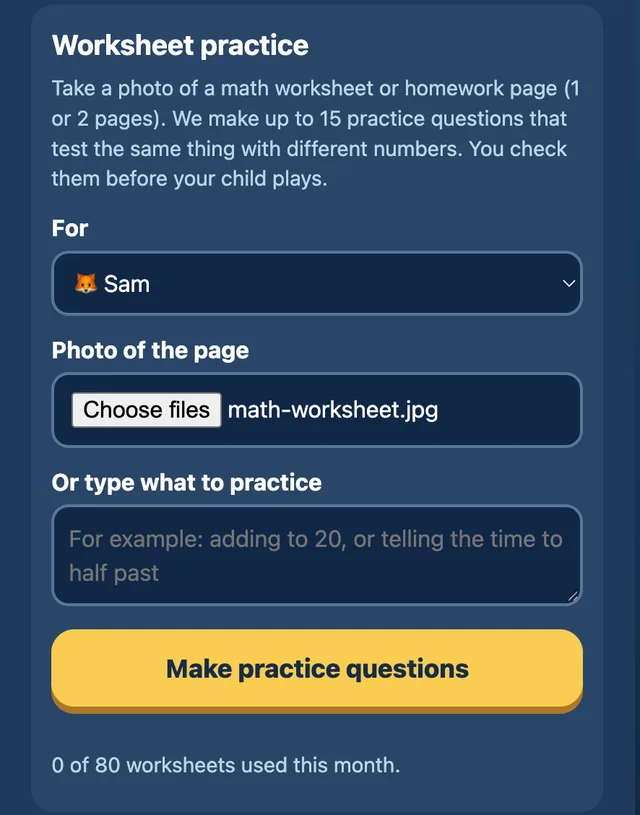
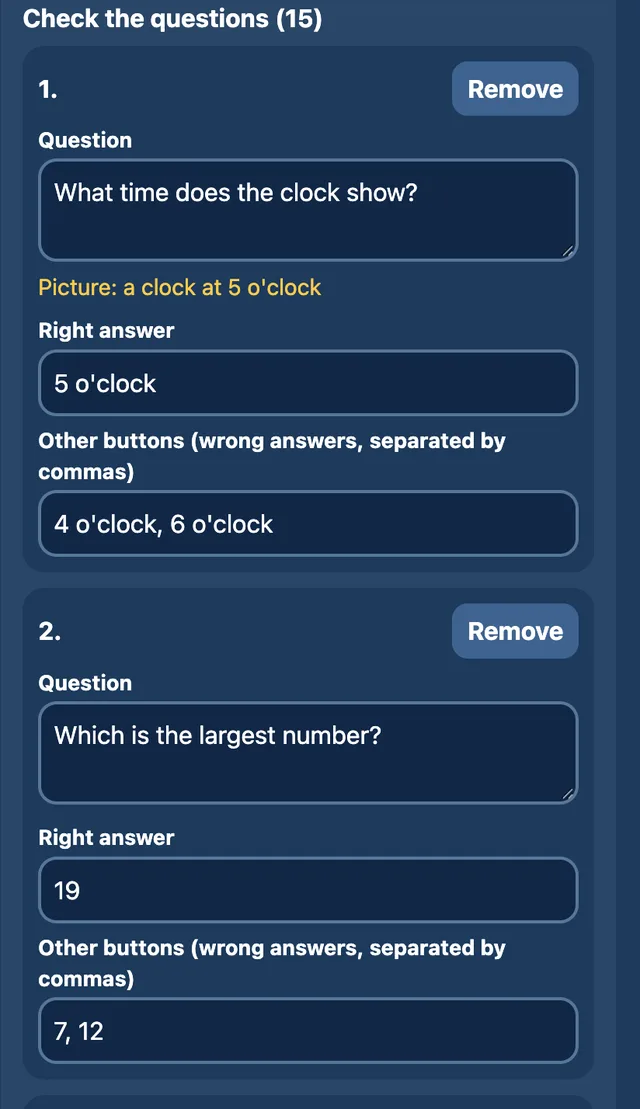
The feature I would want as a parent is the worksheet photo. You photograph the page that came home on Monday, and the arcade “make[s] up to 15 practice questions that test the same thing with different numbers. You check them before your child plays.” A grown-up can also set a reward against a target, with one rule stated on the screen: “Only answers right first time count, starting now. Guessing until a button turns green doesn’t move the bar.” That rule exists because a reward that counts the second guess teaches guessing.
What it is not. I would not call it a reading app, a science app or a stand-in for a teacher, and I would not expect it to hold a four-year-old the way Khan Academy Kids does. Trying it costs nothing and gives you “a sample of 87 questions, saved on this device only”. That is enough rounds to run the three-minute test on us too. The Family Plan “unlocks all 1260 questions, new ones made up as your child plays, and progress on every device”. Starting one means adding a card on Stripe, for “the free trial, or a free card check”.
Run the test on the Arcade too
Trying the games costs nothing: you add a player on the device with a name, a picture, an age from 4 to 12 and an optional PIN. Sit with them for three minutes and count the answers, the same way you would with anything else on this page.
The free sample is 87 questions, saved on that device. The Family Plan adds the worksheet photos, all 1260 questions on every device and a parent report, and starts with “the free trial, or a free card check” on Stripe.
How the arcade works →The five at a glance
| Game | Ages | Cost | Why I would pick it |
|---|---|---|---|
| XtraMath | Any child working on number facts | Free, nonprofit | Ten minutes a day on math fact fluency |
| Prodigy Math | Grades 1 to 8 | Questions free; optional paid Membership | Getting a reluctant child to come back to math at all |
| Khan Academy Kids | Two to eight | Free, no ads | One free app covering math and early reading for a young child |
| Coolmath Games | Points “under 13 users” to Coolmath4Kids | “Free Online Math Games”, by its own home page | Logic, strategy and decision-making; Coolmath4Kids is the math one |
| Power-Up Arcade (ours) | 4 to 12 | Free sample of 87 questions on the device; Family Plan for the rest | Turning tonight’s worksheet into questions asked inside a game |
Which one, for which child
Four or five, and just starting. Khan Academy Kids, and ten minutes of counting things in the kitchen that nobody calls math. More on what helps at that age in math games for kindergarten.
Six or seven, and still counting on fingers. Second grade is the year the Common Core asks children to “know from memory all sums of two one-digit numbers”. So the target is doubles and pairs that make ten rather than general exposure. Math games for 6 and 7 year olds has the card game we used at home, and math fact practice games has the ladder to climb.
Eight and up, and bored of all of it. Prodigy Math, or the arcade, or anything that gets answers happening again. If you are paying for a practice program already and it has stopped working, the honest comparison is in IXL alternatives for kids.
Any age, with homework coming home. I would take the worksheet in the bag over anything an app invents, because it is what the teacher is about to test. The method, with or without an app, is in the guide Turn Math Homework into Practice Games. For the coins in the jar, Counting Money Games for Kids does the same job.
Frequently asked questions
What makes a math game educational?
Nothing official, as far as I have ever been able to find. The working test is the one in this article: in three minutes of play, how many answers does your child produce, and does each one come back marked right or wrong straight away? That is the part doing the teaching. The characters, coins and pets are the reason your child is willing to do it, which matters, but they are not the lesson.
Are educational math games actually effective?
The game is not the active ingredient, the practice inside it is. In their 2013 review in Psychological Science in the Public Interest, John Dunlosky and colleagues rated ten common study techniques and found that “Practice testing and distributed practice received high utility assessments because they benefit learners of different ages and abilities and have been shown to boost students’ performance across many criterion tasks and even in educational contexts.” That work covered learners of many ages and studying rather than math games, so treat it as a principle. A game that asks plenty of questions and brings missed ones back is running a method with good evidence behind it. One that mostly rewards tapping is not.
What are the best free educational math games?
XtraMath for number facts: “Founded as a 501(c)3 non-profit in 2009”, offering to “Build Essential Math Skills in Just 10 Minutes a Day, for Free.” Prodigy Math for a child who wants a world to explore: “Grades 1 to 8. Aligned to your curriculum. Free math and English educational content,” with an optional paid Membership on top. Khan Academy Kids for the youngest: built “for kids ages two to eight,” “100% free - forever,” with “No ads, no subscriptions.”
Is Coolmath Games educational?
Its own description is logic and strategy, and I would not count it as math practice. Its about page describes its games as having “a generous sprinkling of logic, strategy, and decision-making,” and the site has been “the premier destination for fun + learning games since 1997.” Thinking games are worth your child’s time. If the problem is times tables, I would look elsewhere. The company points younger children elsewhere: “For our under 13 users, Coolmath4Kids is an amusement park of math, games, and more, designed to teach math and make it fun!”
Is Prodigy Math free?
The questions are. Prodigy’s own FAQ says “Prodigy Math’s educational content (questions, in-game videos and math manipulatives) is free. Anyone can make a Prodigy Math account and start learning!” Parents can buy an optional Membership, which adds “Goals and Rewards” and “premium features like worksheets, video lessons and extra reports.” Work out your answer to that before it is asked for.
What does it mean when a math game says it is evidence-based?
Usually less than it sounds. Some products cite a tier under the Every Student Succeeds Act, XtraMath's home page among them. The four tiers are not equal. The California Department of Education describes the bottom one as “Tier 4 – Demonstrates a Rationale: practices that have a well-defined logic model or theory of action, are supported by research, and have some effort underway by an SEA, LEA, or outside research organization to determine their effectiveness.” That is a theory plus a study in progress, not a result. Federal school improvement money under “Title I, Section 1003” can only fund “strong, moderate, or promising evidence (Tiers 1–3)”. That is where tier four sits.
How long should my child play an educational math game?
Ten minutes, most days, and stop while they still want one more go. XtraMath, whose home page calls it “the Proven Way to Develop Math Fact Fluency”, sells itself on “Just 10 Minutes a Day.” The research reason for short and frequent over long and rare is distributed practice, which came out of the Dunlosky review with the same high rating as practice testing. The practical reason is that a session ending in a fight costs you tomorrow night as well.