Short answer: free and best at times tables, XtraMath. Free and best for ages two to eight, Khan Academy Kids. Free and best for a child who refuses, Prodigy Math. Paid and best for a bored, able child, Beast Academy. Paid and best for colorful K–5 games, SplashLearn. And if the gap is that none of them practice the exact thing on tonight's worksheet, that is what the Power-Up Arcade Family Plan is for.
Why families leave IXL, and it is usually the SmartScore
When a parent says their child hates IXL, the complaint is usually not about the questions. It is about the number in the corner. IXL's own SmartScore guide explains how it moves. At 80, it says, “learners are considered proficient in a skill.” From 90 up, in what IXL calls the Challenge Zone, “SmartScore increases for correct answers will be small (1-2 points), and penalties for incorrect answers will be larger (3-8 points),” and a child may need “as many as 10 questions correctly in a row” to reach 100.
Read that twice, because it explains the tears. A child chasing 100 is on a scoreboard that falls three to eight points on a slip and climbs one to two on a win. That is deliberate, and for a confident child it works exactly as intended: it stops them guessing their way to a tick and it makes the mastery mean something. For a child who already thinks they are bad at math, it is a machine for proving it. Same design, opposite effect, and nothing about your parenting decides which one you got.
The other common reason is simpler. On IXL's family pricing page, checked 10 October 2026, a single subject is $9.95 a month, the math and language arts combo package is $15.95, and the core subjects package covering math, language arts, science and social studies is $19.95. IXL offers a 30-day satisfaction guarantee. That is reasonable money for a tool a child uses, and dear money for one they argue about every evening.
One caveat before you cancel anything. If IXL is assigned by your child's school, an alternative does not replace it, because the teacher still wants those skills done. What an alternative replaces is the extra practice you were adding at home.
Six IXL alternatives, and the job each one does
Ranked by how many children they suit, not by what they cost us. Prices and quoted claims were checked on 10 October 2026 on each company's own site.
1. XtraMath: free, and the best fix for shaky math facts
If what is actually slowing your child down is that seven times eight takes them four seconds and a finger count, this is the switch to make, and it is free. XtraMath describes itself as “founded as a 501(c)3 non-profit in 2009” and leads with “Build Essential Math Skills in Just 10 Minutes a Day, for Free.” Its programs cover addition, subtraction, multiplication and division, plus custom programs. There is a paid Pro tier that adds enhanced reports and customization, and the core practice does not need it.
What it is not: a curriculum. There are no word problems, no fractions, no geometry. It drills recall and nothing else, and it is plain to look at, which some children prefer and others will not tolerate for a week. Use it alongside something, not instead of everything.
2. Khan Academy Kids: free, and the right answer under about eight
Khan Academy Kids is for “kids ages two to eight” and covers early literacy, reading, writing, language and math, with social-emotional content and creative play alongside. On cost it is unusually blunt: “100% free - forever,” and “No ads, no subscriptions - just high-quality learning for every child, at home or in the classroom.” For a kindergartener or first grader who found IXL joyless, this is the softest landing on the list, and the one most likely to be opened voluntarily.
For older children, Khan Academy's main site carries on through the later grades, also free, from the same non-profit. It is more lesson-and-video than game, so it suits a child who will sit and watch rather than one who needs to be tricked into practice.
3. Prodigy Math: free to play, and the one a reluctant child will actually open
Prodigy wraps math questions inside a fantasy game with battles and characters, which is the whole point: the child comes for the game. Prodigy's own site states that “all of our standards-aligned educational math and English content is free and students can play Prodigy at school or at home,” and describes the paid memberships as “optional” extras that “provide additional features.” So the math is not behind the paywall; the cosmetics and perks are.
Be ready for the trade. The game is deliberately compelling, and plenty of parents find their child plays for forty minutes and answers twenty questions. Membership prices are not published on the main page and differ between the web and the app stores, so check the current price in your own account before you buy anything.
4. SplashLearn: paid, and the closest in feel to a brighter IXL
SplashLearn covers preschool (ages two to five), kindergarten and grades 1 to 5, in math and English. It is the most IXL-like of the alternatives in that it walks a child through graded skills, with far more animation and reward on top. Its site publishes free lesson plans and teaching tools for teachers but does not show a parent price on the home page, so you will see the figure at sign-up. Worth a look if your child liked IXL's structure and bounced off its plainness.
5. Beast Academy: paid, and the only one here for a child who is bored
If you are leaving IXL because your child finishes it in six minutes and is unimpressed, Beast Academy from Art of Problem Solving is the one to look at. Its site describes it as being for “advanced math beasts ages 6–13,” with online self-paced access covering Levels 1 to 5 and live online classes at Levels 2 to 5. The books are sold by age band, from Level 1 at ages 6 to 8 up to Level 5 at ages 10 to 13. It is a paid subscription, with yearly and book-bundle options, and there is a free demo to try before you commit. Check the current price on their own site before you sign up.
It is genuinely harder, not merely longer, which is the distinction most lists miss. A child who is behind will find it discouraging. A child who is ahead and sulking will find it the first math they have respected all year.
6. Power-Up Arcade Family Plan: what about the exact thing on tonight's worksheet?
The Family Plan fills a gap the other five share. Every tool above practices the curriculum. None of them practices this page, the one in the backpack, the one with four red marks on it. So you either hunt through a skill tree for something that looks close, or you make up questions yourself at half past seven in the evening.
The Arcade's math games work the other way round. You photograph the worksheet, and about a minute later you get up to 15 twin questions: the same skill with different numbers, so the homework answers are never handed over. You check, edit or delete every question before your child sees it, and the photo is deleted as soon as it has been read. Then they play one of 17 games, racing or swinging or kicking penalties, and the questions arrive inside the game.
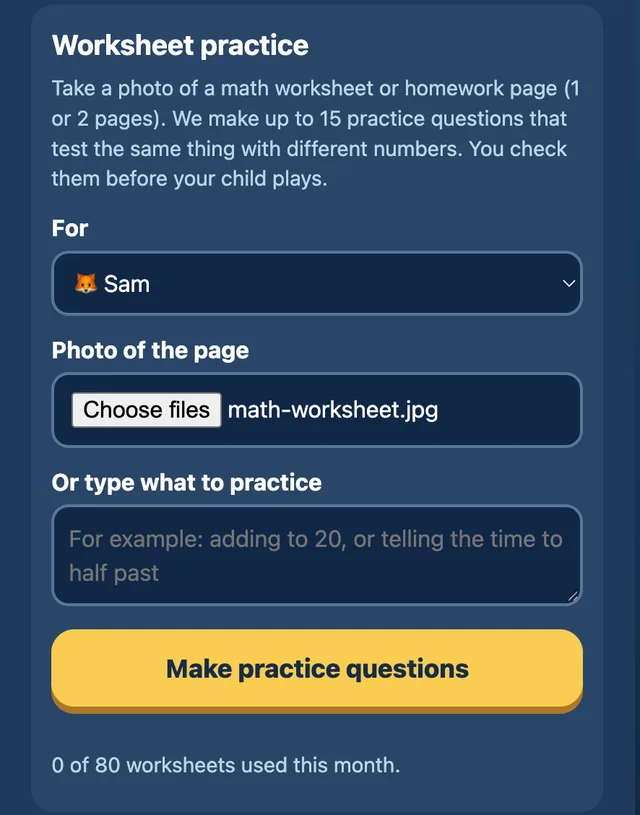
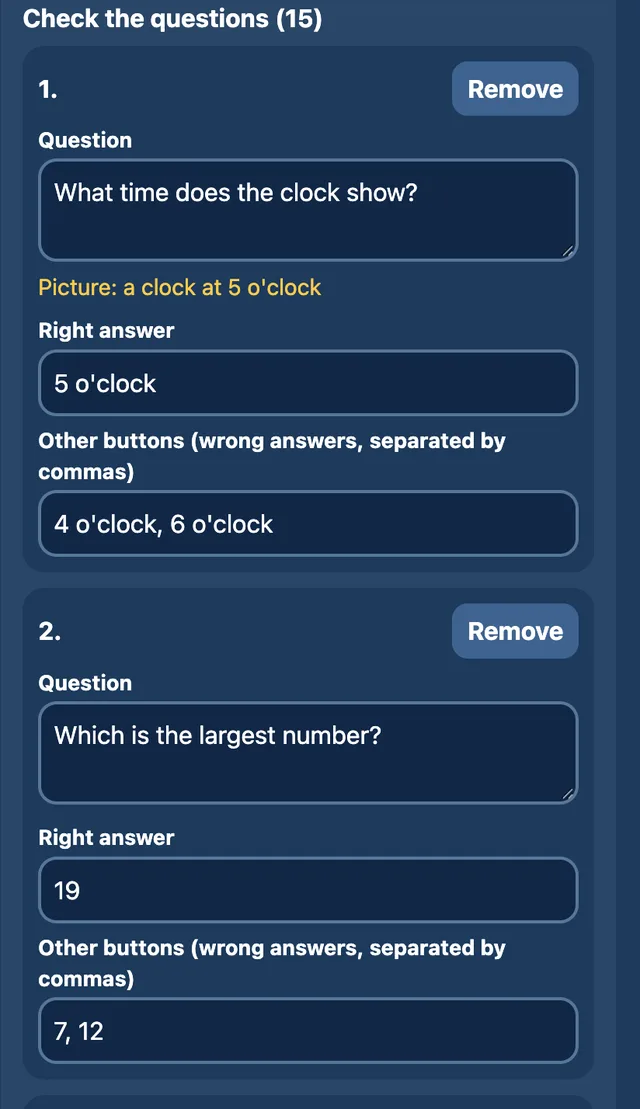
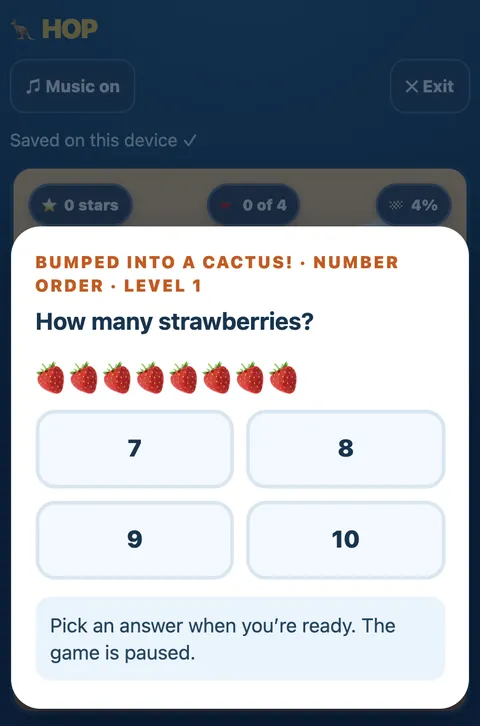
What it is not, and this matters: not a curriculum and not a replacement for school. There is no reading, no science, no lesson videos and no teacher. If you want a graded scheme that marches a child through every skill in the year, IXL or SplashLearn does that and this does not. What this does is the ten minutes after homework, on the thing they got wrong today.
Try the games before you decide anything
17 games for kindergarten to 6th grade, ages 5 to 12. Trying a few needs no account: type a first name, pick an animal, go. The Family Plan adds worksheet photos, all 1,260 questions on every device, up to 6 players and a parent report.
Try a few games free, no account needed. Family Plan: 7 days free on your first plan, then $9.99 a month or $99 a year. Cancel anytime from Manage payments.
How worksheet photos work →The six at a glance
| Tool | Ages / grades | Cost (checked 10 Oct 2026) | Best at |
|---|---|---|---|
| XtraMath | Not stated; fact practice by program level | Free (non-profit); optional paid Pro | Math facts, 10 minutes a day |
| Khan Academy Kids | Ages 2–8 | Free, no ads, no subscriptions | Early years math and reading together |
| Prodigy Math | School-age, standards-aligned | Free to play; optional paid membership | Getting a reluctant child to start |
| SplashLearn | Preschool (2–5), K, grades 1–5 | Paid; parent price shown at sign-up | A brighter, friendlier skills ladder |
| Beast Academy | Ages 6–13, Levels 1–5 | Paid subscription (yearly and bundle options); free demo | A child who finds IXL too easy |
| Power-Up Arcade (ours) | K–6th grade, ages 5–12 | A few games free with no account; Family Plan $9.99/mo or $99/yr after a 7-day trial | Practicing tonight's worksheet specifically |
Every figure above comes from the company's own site on 10 October 2026. Prices move, so check before you pay.
Do this tonight, with no app at all
You do not need a subscription to run the thing that actually works. Here is the whole routine. It takes ten minutes and a pen. On nights you are too tired, the Power-Up Arcade writes the practice questions from a photo of the worksheet.
- Take the three they got wrong. Not the page. Three questions, from today.
- Write two twins for each one. Same skill, different numbers: if they missed 34 + 28, you write 46 + 27 and 55 + 38. Six questions in total, on a scrap of paper.
- Set a timer for ten minutes and sit next to them. Count only the first answer they give, so guessing until something is right does not pay.
- Stop when the timer goes even if you are mid-question. Finishing on time is the reward, and a child who knows the end exists works harder inside it.
- Re-ask the two they missed tomorrow, first thing, before anything new. The spacing between the attempts is doing the work here, not the number of questions.
Why spacing rather than volume: psychologists have described the forgetting curve since Hermann Ebbinghaus's work in the 1880s, and the broad finding, often called the spacing effect, is that the same practice spread across days tends to be remembered better than the same practice crammed into one sitting. Which is good news on a Tuesday night, because it means ten minutes beats an hour.
How to choose, in three questions
Why are you really leaving? If the answer is “she cries,” do not buy a harder tool. Take the scoreboard away entirely for a fortnight, use XtraMath or nothing, and see what comes back. If the answer is “he is bored,” free will not fix it and Beast Academy probably will.
What is the actual gap? Recall, like times tables and number bonds, is a different problem from understanding, like place value or fractions. Drill helps the first and does very little for the second. If your child can explain what they are doing but is slow, drill. If they are fast but wrong, they need teaching, not more practice.
Will they do it without a fight? This is the one parents discount and it decides everything. The ten minutes they will do beats the thirty minutes you have paid for and have to enforce. Try the free options first for exactly this reason: you learn what your child will tolerate before any money changes hands.
Frequently asked questions
Is there a free alternative to IXL?
Three worth knowing. XtraMath is a 501(c)(3) non-profit built around short daily fact practice. Khan Academy Kids is free for ages two to eight with no ads and no subscriptions. Prodigy Math is free to play, and Prodigy's own site says the standards-aligned math and English content is free. None is a like-for-like copy of IXL's skill-by-skill coverage, but between them they cover facts, early years and motivation at no cost.
Why does my child find IXL so frustrating?
Usually the SmartScore, not the math. IXL's own guide puts proficiency at 80, and says that from 90 up a correct answer adds 1 to 2 points while a wrong one costs 3 to 8, with as many as 10 correct in a row needed to reach 100. That is a mastery design, and it lands very differently on a confident child than on an anxious one.
What if IXL is too easy for my child?
Beast Academy, for ages 6 to 13 across Levels 1 to 5. It is harder rather than longer, which is the right medicine for boredom and the wrong one for a child who is behind.
Will switching confuse what the school is doing?
No, as long as you keep anything the teacher assigns. If IXL comes from school, do the assigned skills and change only the extra practice you were adding at home. Twin questions on the same skill never conflict with a teacher's plan, because they are the same content with different numbers.
Could I not just make them redo the worksheet?
You can, and it is better than nothing, but a child who has seen the page once often remembers the answer rather than the method, which flatters everybody. Changing the numbers and keeping the skill is what tells you whether they can actually do it.
What does your Family Plan cost?
Your child can try a few games free, with no account. The Family Plan is $9.99 a month or $99 a year after a 7-day free trial, which takes a card at checkout and includes 3 worksheet photos. It opens up all 17 games and all 1,260 questions on every device, 80 worksheet photos a month, up to 6 players, a parent report and a downloadable CSV of each child's results. Cancel anytime from Manage payments.