Short answer: free, no ads, best all-rounder for a five-year-old, Khan Academy Kids. Free in a browser and the one a reluctant child will actually open, PBS KIDS Games. Free counters and ten frames for when you have nothing to count with, Toy Theater. Free early-learning program plus a paid membership, Starfall. For a child who would rather drive a monster truck than sit at a worksheet, try the Power-Up Arcade, where the questions turn up inside the games. And the ten-minute counting game in the yellow box below needs nothing but a handful of pasta and your attention, which at this age is the strongest ingredient you have.
What kindergarten math actually covers
Worth knowing before you choose a game, because most "kindergarten math" apps teach one slice of it and skip the rest. The Common Core kindergarten standards split the year into five domains, and only one is arithmetic.
- Counting and cardinality. K.CC.A.1 asks a child to “Count to 100 by ones and by tens,” and K.CC.A.3 to “Write numbers from 0 to 20.” K.CC.C.7 adds comparing “two numbers between 1 and 10 presented as written numerals.”
- Addition and subtraction, gently. K.OA.A.5 is the whole arithmetic target for the year: “Fluently add and subtract within 5.” Within five. Everything else in that domain is done with objects, drawings or fingers, including finding the number that makes ten.
- Teen numbers as ten and some more. K.NBT.A.1 asks children to “Compose and decompose numbers from 11 to 19 into ten ones and some further ones,” recording it “by a drawing or equation (such as 18 = 10 + 8).” This is where ten frames earn their keep.
- Measuring and sorting. K.MD.A.1 is “Describe measurable attributes of objects, such as length or weight,” and K.MD.B.3 is “Classify objects into given categories; count the numbers of objects in each category and sort the categories by count.” Tidying the Lego by colour is on the curriculum.
- Shapes, flat and solid. Naming squares, circles, triangles, rectangles, cubes, cones and spheres, and describing where things are using words like above, below and beside.
Read that list and the shape of the year becomes obvious. A child who spends their ten minutes a night on "4 + 2" is practising one line of five domains. Shapes, sorting, comparing and measuring get almost no airtime at home, and they are the easiest ones to do while emptying a dishwasher.
The one thing worth checking tonight
Reciting numbers and understanding quantity are separate skills, and they come apart often enough that the standards spell the second one out on its own. K.CC.B.4.b asks a child to “Understand that the last number name said tells the number of objects counted,” and that “The number of objects is the same regardless of their arrangement or the order in which they were counted.”
Here is the thirty-second test. Put seven buttons on the table in a line. Ask your child to count them. Then ask, without touching anything, "so how many buttons are there?" A child who has the idea answers seven straight away. A child who has only the song starts again at one. Then push the same seven buttons into a messy pile and ask again. If the answer changes, or they feel they need to recount, that is the gap, and it is a completely normal gap for October of the kindergarten year.
The skill underneath it has a name worth knowing, because it tells you what a good game looks like. Subitizing is seeing a small quantity instantly without counting it: three dots on a die, four fingers held up. The maths educator Douglas Clements wrote a much-reprinted piece for the National Council of Teachers of Mathematics called "Subitizing: What Is It? Why Teach It?", and the argument has stuck because the practice is so cheap. Dice, dominoes, fingers, ten frames and playing cards all train it. A game that flashes a pattern of dots and asks "how many?" is doing more for a five-year-old than a game that asks them to type a sum.
The 10-minute counting game, for tonight
No app, no printing, no preparation. A handful of pasta shells, dried beans or buttons, and a tea towel. Five rounds, two minutes each. This is the routine that worked at our table, and the order matters more than the objects do.
- Two minutes: how many? Drop a small pile on the table, somewhere between three and eight. Ask "how many?" and let them count out loud, touching each one. When they finish, ask once more: "so how many are there?" If they recount, that is fine, say the number with them and move on. You are after the habit of finishing with a total, not speed.
- Two minutes: the tea towel flash. Lay out four shells, cover them, lift the towel for about a second, cover them again, and ask how many. Start with two and three, because those are seeable in one glance. Work up to five. This is the subitizing bit, and it is the round children ask to play again.
- Two minutes: hide some. Count out five together. Then cover the pile, slide two out from under the towel where they can see them, and ask how many are still hidden. Fingers absolutely allowed. This is "fluently add and subtract within 5" from the standards, except it feels like a magic trick.
- Two minutes: which pile is more? Make two piles, six and nine, and ask which has more. Then make them equal and ask again. Then make one pile long and thin and the other squashed up, with the same number in each, and ask again. The squashed-up version is the one that catches children out, and noticing that is the lesson.
- Two minutes: let them run it. Swap seats. They set the pile, they lift the towel, you answer, and you get one wrong on purpose and let them correct you. Being the one who knows is the reward, and it is the part that gets you a yes tomorrow night.
Two rules that double the value. Keep every number small, under ten, because the point is meaning rather than range. And stop at ten minutes even if they are enjoying it, especially if they are enjoying it. Finishing while they still want one more go is what makes tomorrow easy.
Four free math games for kindergarten, and the job each one does
All four can be used free, and all four were checked on 13 October 2026. They are not really competing, because they do different jobs. The useful question is which one fits the bit your child is stuck on.
1. Khan Academy Kids: the free all-rounder
The one I would install first. It is run by the Khan Academy nonprofit, its own page describes it as “100% free - forever,” and the FAQ there states plainly: “We don't show ads in the app.” It is built for “kids ages two to eight” and covers “foundational skills in early literacy, reading, writing, language, and math” rather than math alone, which at five is a feature, not a dilution. A five-year-old gets counting, comparing and shapes in the same place as letters, and the app decides what comes next so you do not have to.
What to know before you commit the evening to it: because it spans ages two to eight, the first sessions can
sit too easy for a confident child, and there is no "skip to counting to twenty" button you can lean on. It is
an app rather than a browser game, so it lives on a phone or tablet. Schools and districts can pay for a
separate version with a teacher dashboard. A family pays nothing.
khanacademy.org/kids
2. PBS KIDS Games: the one they will actually open
Free in a browser, no account, no download, and the single best answer to a child who refuses anything that looks like school. The math section runs on characters they already know, with games like Count-y Fair and Patternpalooza Fair, and the patterning and sorting ones quietly cover the measurement and data domain that most math apps ignore completely.
The honest limitation is that it is a shelf of games rather than a path. Nothing tracks what your child has
done, nothing decides what they need next, and the math density varies a lot from one game to the next: some
ask a question every few seconds, others are mostly animation. Watch one round over their shoulder before you
decide it counts as practice.
pbskids.org/games/math
3. Toy Theater: free counters and ten frames for you
This one is a tool for the parent more than a game for the child, and it is the page I have open most often. The site calls itself “free educational games specially designed for elementary-aged students,” and its virtual manipulatives section is the valuable half: colour counters, two-colour ten frames, a rekenrek, an abacus, base ten blocks, a hundreds chart, number lines, dice and spinners. All of it works in a browser with nothing to install.
Why it matters for kindergarten specifically: the teen numbers standard asks children to see 18 as ten and
eight, and that is close to impossible to explain in words and nearly obvious with two ten frames on a screen.
Put six counters in a frame, ask how many empty spaces are left, and you have taught making ten without
saying the phrase. The site does carry advertising, and there is a paid membership, but the manipulatives are
free to use.
toytheater.com, virtual manipulatives
4. Starfall: free program, paid membership
Starfall is a 501(c)(3) nonprofit, and the line on its home page is “Free for every child, forever.” The free side is the reason most parents know the name, and it is genuinely generous. It is also, on the site's own framing, part of the picture rather than all of it: the home page says “Members Get More” and that “Members fund our free Learn-to-Read program.”
If you decide the fuller sequence is worth it, the Home Membership is listed at $35.00/yr and
“Serves a single family household (including grandparents) for one year on computers and mobile
devices.” That is a year, paid once, not a rolling subscription. The site is also stronger on reading
than on math, so if math is the only worry, try the free activities before paying for anything, and spend the
$35 on a box of dominoes and a bag of counters if the free side already does the job.
starfall.com
5. The Power-Up Arcade: what will it ask a five-year-old?
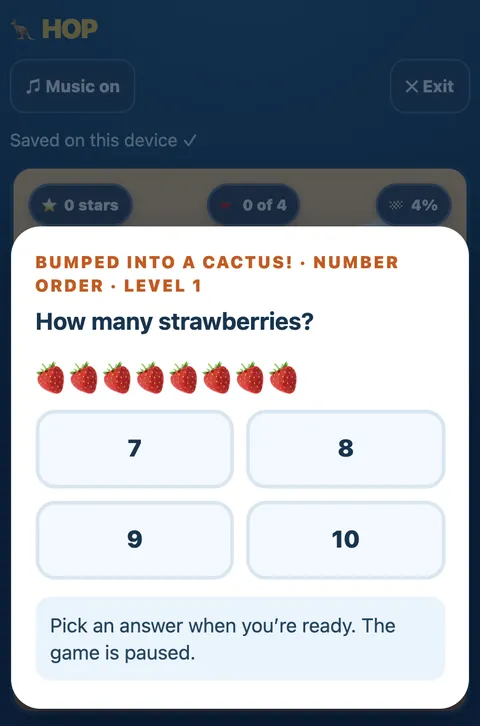
At the easiest level the questions are genuinely kindergarten questions. These are real ones from the bank: "Count on. Fill in the blanks: 1, __, 3, __, 5, __, 7." "Which number is smaller, 6 or 9?" "Is this a triangle or a square?" "A rectangle has __ corners." "6 counters are in the ten frame. How many empty spaces are there?" "Which car is 1st?" Counting, comparing, shapes, patterns, ordinal numbers and ten frames, which matches the five domains above more closely than a pure arithmetic app does.
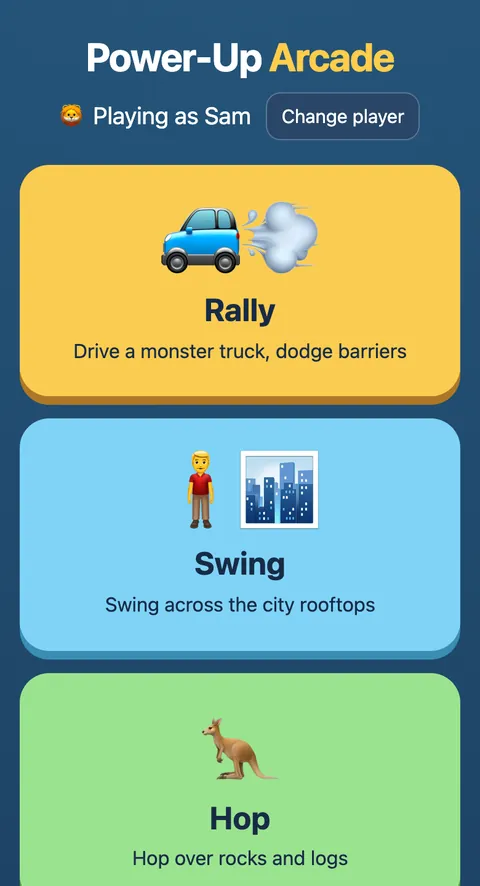
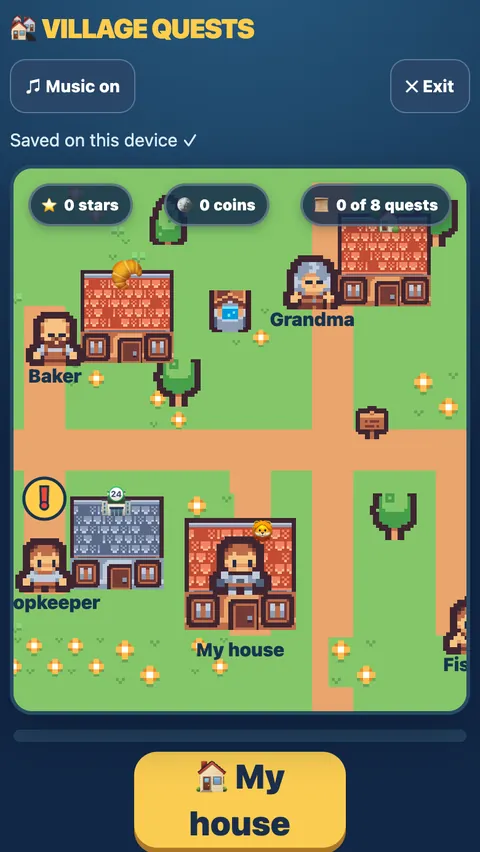
The difference from the four above is where the questions appear. Your child picks a game, races or swings or kicks a penalty, and every so often it pauses for one question and waits. Nothing is on a timer. Answering right first time earns stars and a short power-up, and that first-try rule is deliberate: a reward that counts the second guess teaches guessing.
What it is not, and this matters more in kindergarten than in any other year. It is not a curriculum, there is no reading or science, and there is no teacher. The worksheet-photo feature, which is the main reason older children use it, is close to useless at five simply because there is often no homework coming home yet. And nothing on a screen will beat the pasta shells for the cardinality gap at the top of this page. What this does is the ten minutes when you have run out of patience for pasta shells, three evenings a week, with questions pitched at the right level and a report you can look at later.
Try the games before you decide anything
17 games for kindergarten to 6th grade, ages 5 to 12. Trying a few needs no account: type a first name, pick an animal, go. The Family Plan adds worksheet photos, all 1,260 questions on every device, up to 6 players and a parent report.
Try a few games free, no account needed. Family Plan: 7 days free on your first plan, then $9.99 a month or $99 a year. Cancel anytime from Manage payments.
How the arcade works →The five at a glance
| Game or tool | Ages | Cost (checked 13 Oct 2026) | Best at |
|---|---|---|---|
| Khan Academy Kids | 2 to 8 | Free, no ads | One free app that covers math and reading and picks what comes next |
| PBS KIDS Games | Preschool up | Free in a browser, no account | Getting a reluctant child to start, plus patterns and sorting |
| Toy Theater | Elementary | Free with ads; paid membership exists | Ten frames, counters and a rekenrek when you have nothing to count with |
| Starfall | Pre-K up | Free program; Home Membership $35.00/yr | Early reading first, with number work alongside it |
| Power-Up Arcade (ours) | 5 to 12, K to 6th | Some games free, no account; Family Plan $9.99/mo or $99/yr after 7 days free | Counting, comparing, shapes and ten frames asked inside a game they chose |
Three things not to worry about this year
Fingers. A five-year-old counting on their fingers is doing exactly what the standards expect. K.OA.A.1 explicitly lists fingers among the ways a child may represent addition and subtraction, alongside objects, drawings and acting situations out. Fingers become worth nudging away at seven or eight, when recall should be faster than counting. Not now.
Writing numbers backwards. A reversed 3 or a 7 that faces the wrong way is a handwriting stage, not a math problem. The standard asks them to write numbers 0 to 20, and a wobbly 5 still counts as a 5. Say the number, not the shape.
Being slower than the child next to them at the school gate. Kindergarten classes contain children nearly a year apart in age, which at five is an enormous fraction of a life. If you want something concrete to judge against, use the standards above rather than another family's anecdote, and if the gap genuinely worries you, the person to ask is the teacher, who sees thirty of them every day.
Frequently asked questions
What math should a kindergartener know?
Counting, and what counting means. The Common Core kindergarten standards ask a child to “Count to 100 by ones and by tens” and to “Write numbers from 0 to 20,” but the load-bearing one is K.CC.B.4.b: “Understand that the last number name said tells the number of objects counted,” and that “The number of objects is the same regardless of their arrangement or the order in which they were counted.” Alongside that sit comparing two numbers from 1 to 10, “Fluently add and subtract within 5,” making ten from any number 1 to 9, describing and comparing length and weight, sorting objects into groups and counting each group, and naming flat and solid shapes. Five domains in total, and only one of them is arithmetic.
Are math games good for a five-year-old, or is it just screen time?
It depends entirely on whether the game asks your child for an answer. A game where numbers drift past while a character jumps is entertainment with numbers painted on it. A game that stops, poses a question, waits, and then tells your child whether they were right is practice, and practice is what moves a skill. The useful test takes one minute: sit next to them and count how many times in that minute they have to produce an answer. Fewer than five and it is mostly screen time. At five, ten focused minutes beats forty distracted ones, and anything you can do with real objects on a real table beats both.
What are the best free math games for kindergarten?
Khan Academy Kids is the one to start with: a nonprofit app for “kids ages two to eight” that its own site calls “100% free - forever,” with no ads and no subscription. PBS KIDS Games is the best for a child who will only play something with a character they love, and it runs free in a browser with no account. Toy Theater is worth bookmarking for yourself rather than your child: free counters, ten frames, a rekenrek and dice for when you have nothing physical to hand. Starfall is a 501(c)(3) nonprofit whose free program it describes as “Free for every child, forever,” with a Home Membership at $35.00/yr for everything else. All four were checked on 13 October 2026.
How long should a kindergartener practice math each day?
Ten minutes, and stop while they still want another go. At five the limit is attention rather than ability, and a session that ends in a fight costs you tomorrow as well as tonight. Spreading practice out also helps it stick: psychologists have studied the forgetting curve since Hermann Ebbinghaus's work in the 1880s, and the broad finding, usually called the spacing effect, is that the same amount of practice spread across several days tends to be remembered better than one long sitting. Four short goes across a week beat one long Sunday, and at this age most of those four should involve real objects you can push around a table.
My child can count to 50 but cannot say how many things are on the table. Is that normal?
Yes, it is extremely common, and it is the single most useful thing to work on. Reciting the number sequence and understanding quantity are two different skills, which is why the standards spell the second one out separately. A child who counts five buttons perfectly and then has to recount when you ask how many there were has the song but not the meaning yet. The fix is slow, boring and effective: count small sets of real objects out loud together, then ask “so how many?” and wait. Weeks rather than days, and then it clicks. The tea-towel round in the yellow box above is the fastest version of it I know.
Should math practice be timed at this age?
No. Timing is a tool for breaking a counting habit in a seven or eight-year-old who already knows a fact and is rebuilding it out of habit. A five-year-old is supposed to count, often on their fingers, and a clock on the screen at this stage mostly teaches them that math is the thing that makes them panic. Turn timers off, let them use their fingers, and if a free game cannot be played untimed, pick a different game. Timed fact practice has its place later, and that is covered in math fact practice games.
Do the Power-Up Arcade games work for kindergarten?
Yes, at the easiest level, and it is worth knowing exactly what that level is before you decide. The questions a five-year-old meets are things like “Count on. Fill in the blanks: 1, __, 3, __, 5, __, 7,” “Which number is smaller, 6 or 9?”, “Is this a triangle or a square?” and “6 counters are in the ten frame. How many empty spaces are there?” Those arrive inside one of 17 math games, so your child is answering while racing or swinging rather than sitting at a worksheet. The worksheet-photo feature matters less in kindergarten than later, simply because there is often little homework coming home yet. A few games are free with no account at all, which is a sample of 87 questions on the device, and that is enough to see whether the format suits your child.