Short answer: ten minutes of fact practice, free and nonprofit, XtraMath. The one a 6-year-old sits with happily, Khan Academy Kids. A free browser shelf sorted by grade, Math Playground. Free base ten blocks and a 120 chart, Toy Theater. The card game in the yellow box below costs nothing and needs one deck of cards.
One disclosure before the list. We make one of the five things on this page, the Power-Up Arcade. So every claim about the other four is quoted from that organisation's own site, each one was checked in October 2026, and all four can be used for free. If a free one does the job, use the free one. The card game cost us nothing and moved my own 7-year-old further than any app did.
What 1st and 2nd grade math actually covers
Worth two minutes before you pick anything, because the gap between "my child is behind at math" and "my child has not met that yet" usually lives here. These are the Common Core standards for the two years.
- First grade is add and subtract within 20. 1.OA.C.6 asks children to “Add and subtract within 20, demonstrating fluency for addition and subtraction within 10,” and it lists the strategies by name: “counting on; making ten (e.g., 8 + 6 = 8 + 2 + 4 = 10 + 4 = 14); decomposing a number leading to a ten (e.g., 13 - 4 = 13 - 3 - 1 = 10 - 1 = 9)” and “creating equivalent but easier or known sums (e.g., adding 6 + 7 by creating the known equivalent 6 + 6 + 1 = 12 + 1 = 13).” Those strategies are the curriculum, not a shortcut around it.
- First grade also counts to 120 and takes numbers apart. 1.NBT.A.1 is “Count to 120, starting at any number less than 120.” 1.NBT.B.2.b says “The numbers from 11 to 19 are composed of a ten and one, two, three, four, five, six, seven, eight, or nine ones,” and 1.NBT.C.5 asks a child to “mentally find 10 more or 10 less than the number, without having to count.”
- Second grade wants the facts from memory. 2.OA.B.2 is the sentence the whole year turns on: “Fluently add and subtract within 20 using mental strategies. By end of Grade 2, know from memory all sums of two one-digit numbers.” Knowing a fact from memory is a different request from anything the years before it asked for.
- Second grade adds hundreds, skip counting, and odd and even numbers. 2.NBT.A.2 is “Count within 1000; skip-count by 5s, 10s, and 100s,” and 2.NBT.B.5 is “Fluently add and subtract within 100 using strategies based on place value.” Over in the other domain, 2.OA.C.3 asks children to “Determine whether a group of objects (up to 20) has an odd or even number of members.”
- The equal sign is on the list too. 1.OA.D.7 asks a child to “Understand the meaning of the equal sign, and determine if equations involving addition and subtraction are true or false,” with examples like “6 = 6, 7 = 8 - 1, 5 + 2 = 2 + 5.” Plenty of six-year-olds read the equal sign as "and now write the answer", which is worth catching early.
The one shift these two years are about
Ask your child 6 + 7 and watch them rather than listen to them. A child who has the fact says 13 almost before you finish. A child who does not will look up, go quiet, move their fingers under the table, or say "six, seven, eight" under their breath. Both are normal at 6. By the end of second grade the standards expect the first one.
The route there is not more flashcards. Read 1.OA.C.6 again and the official path is doubles and ten: 6 + 7 becomes 6 + 6 + 1, and 8 + 6 becomes 8 + 2 + 4. A child who knows doubles cold and knows what makes ten can rebuild almost any fact in a second, and the facts they rebuild often enough stop needing rebuilding. So the practice worth doing at home is small, specific and repeated: doubles, pairs that make ten, and then the facts next door to those.
Why answering beats watching has been studied for a long time, under the name the testing effect. In a 2006 paper in Psychological Science, Henry Roediger and Jeffrey Karpicke had students study prose passages and then either take recall tests or restudy the material; on delayed tests, “prior testing produced substantially greater retention than studying.” Those were older students and passages of text rather than seven-year-olds and number facts, so treat it as a principle and not a promise. The principle is enough to choose by: if your child is being asked and told whether they were right, something is happening. If numbers are drifting past a cartoon, it is television with digits on it.
The 10-minute card game, for tonight
One deck of cards, face cards taken out, aces count as 1. Five rounds, two minutes each. It targets doubles and pairs that make ten, which is the pair of skills the first-grade standard leans on hardest, and it works for a 6-year-old and a 7-year-old sitting at the same table.
- Two minutes: make ten. Deal twelve cards face up. Your child picks up any two that total ten and keeps the pair. When they stall, do not tell them the answer, point at one card and ask "what does this one need?" Pairs that make ten are the engine of every making-ten strategy in the standard.
- Two minutes: doubles snap. Flip one card and both of you race to say the double. Four gives eight, seven gives 14. Go in order the first few nights, then shuffle. Doubles are the cheapest facts to learn and they open up the rest.
- Two minutes: one more than the double. Flip one card, say the double, then add one. Seven gives 14, so seven and eight gives 15. This is the standard's own example, 6 + 7 as 6 + 6 + 1, and when a child spots that trick for themselves the week gets easier.
- Two minutes: ten and some more. Put a ten card down and flip one more. Say the teen number, then say it the long way: "13, that is a ten and a three." This is 1.NBT.B.2.b, and two minutes a night on it does more for place value than a worksheet does.
- Two minutes: let them run it. Swap seats. They flip, you answer, and you get one wrong on purpose so they can correct you. Being the one who knows is the reward, and it is what buys you a yes tomorrow.
Two rules that double the value. Keep every total inside 20, because that is the range both years care about. And stop at ten minutes even when it is going well, especially when it is going well.
Four free math games for 6 and 7 year olds, and the job each one does
All four can be used free, and all four were checked in October 2026. They are not really competing. One drills facts, one teaches a 6-year-old broadly, one is a shelf of browser games, and one is a set of tools for you.
1. XtraMath: the free one aimed at the actual target
If second grade is asking your child to know sums from memory, this is the free program built for exactly that. XtraMath is a 501(c)3 nonprofit, founded in 2009, and its own home page promises to “Build Essential Math Skills in Just 10 Minutes a Day, for Free” across “addition, subtraction, multiplication, and division facts.” Its pricing page lists a Standard plan at “$0/free forever” and answers the obvious question plainly: the free plan is “genuinely free, no trial period, no credit card, no catch.”
What to know before you start it. The practice is a fact drill against a response-time threshold, so it
suits a child who already has some facts and needs them faster, and it can land badly on a child who is
still working everything out. The paid Family Pro tier is “$6 / year” with three children
included, and what it adds is reporting rather than different practice: “Pro includes enhanced
reports, more customization options, out-of-school access, family reports, and other teacher-friendly
features.”
xtramath.org
2. Khan Academy Kids: still the best free app at 6
A 6-year-old is inside this app's range and a 7-year-old is near the top of it, which is the honest way to put it. Khan Academy Kids is built “for kids ages two to eight,” its own page says “100% free - forever” with “No ads, no subscriptions,” and it covers “foundational skills in early literacy, reading, writing, language, and math” rather than math alone. The site also says the curriculum was “Created in collaboration with learning experts at Stanford” and aligns with Common Core.
The limitation is the one that comes with the age range. A confident second grader can outgrow the math
content while still enjoying the characters. Schools pay separately, “For $5 per student,” for a teacher dashboard.
A family pays nothing.
khanacademy.org/kids
3. Math Playground: free games sorted by grade
Free to use, and the fastest way to find something at the right level: the site keeps separate 1st Grade Math and 2nd Grade Math pages, and describes itself as “Math puzzles, logic challenges, and problem-solving activities for grades K-6.” For this age I would start with the number puzzles.
Two honest notes. Its about page explains the funding plainly, saying Math Playground “uses
advertising to support free access to its educational content”, with a “Go Ad-Free!”
subscription if the ads bother you, and the math density varies a lot from one game to the next. Watch one round over your child's
shoulder and count how many answers they actually produce before you count it as practice. It is run by
Math Playground LLC, with a copyright line of “2002-2026,” so it has been going longer than
most of them.
mathplayground.com, 1st grade
4. Toy Theater: free base ten blocks, for you
This is a tool for the parent rather than a game for the child, and it is the tab I have open most often at homework time. Its virtual manipulatives page is free to use in a browser and holds base ten blocks, a hundreds chart, a 120 chart, place value disks, a place value mat, number bonds, part-part-whole frames, a rekenrek and ten frames.
Why it matters this year rather than last. Place value is half of first and second grade math and it is
close to impossible to explain in words. Put out one ten block and three ones and 13 stops being a shape on
a page. The site does carry advertising, which is the price of it being free.
toytheater.com, virtual manipulatives
5. The Power-Up Arcade, which is ours
Since this one is ours, here is the part a parent of a 6 or 7-year-old needs rather than the sales version. Your child picks a game, races or swings or takes a penalty, and every so often the game stops, asks one question and waits. There are 17 games to pick from, and a grown-up can set a reward against a target of right answers, with one rule on the screen: “Only answers right first time count, starting now. Guessing until a button turns green doesn't move the bar.” That rule is deliberate, because a reward that counts the second guess teaches guessing.
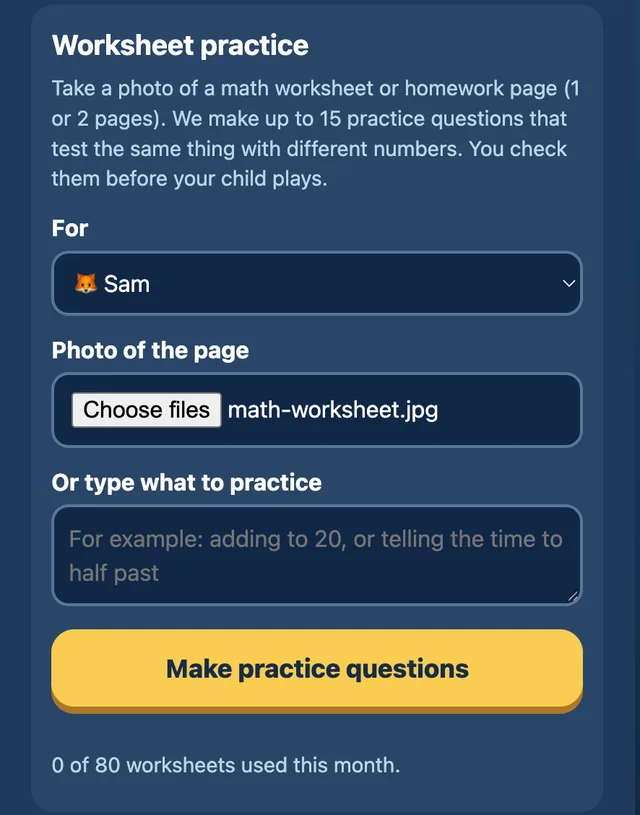
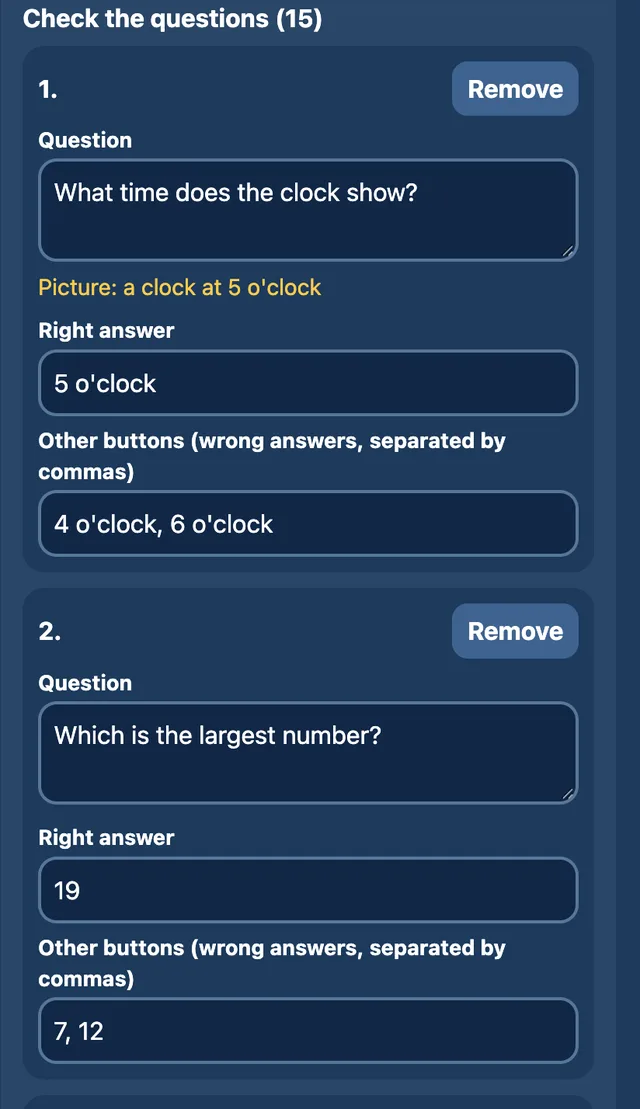
The feature that starts to matter at this age, and did not at 5, is the worksheet photo. Homework begins arriving, and a page of sums that came home on Monday is the most useful practice your child could do on Wednesday. You photograph the worksheet, “1 or 2 pages,” and the arcade makes “up to 15 practice questions that test the same thing with different numbers.” You check them before your child plays, which is the part I would want as a parent, and worksheet practice comes with the Family Plan.
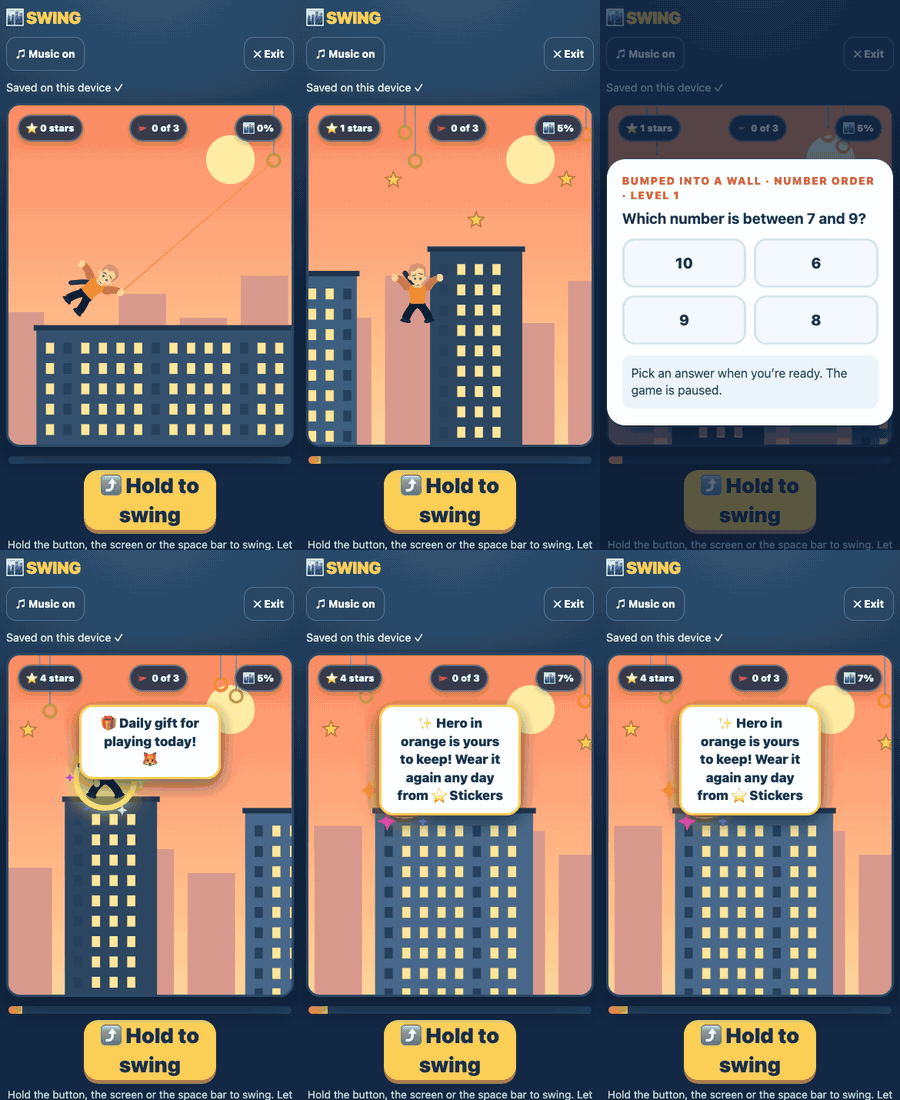
What it is not. It is practice, not a teacher, and it will not teach place value the way one ten block and three ones will. Trying it free gives you “a sample of 87 questions, saved on this device only,” which is plenty to see whether your child likes answering inside a game or finds it annoying. The Family Plan “unlocks all 1260 questions, new ones made up as your child plays, and progress on every device,” and it is the ten minutes for the evenings when nobody has the patience for cards.
Try the games before you decide anything
Trying the games costs nothing: you add a player on the device with a name, a picture, an age from 4 to 12 and an optional PIN. The Family Plan adds the worksheet photos, all 1260 questions on every device, and a progress report for each child.
The free sample is 87 questions, saved on that device. The Family Plan starts with a free trial.
How the arcade works →The five at a glance
| Game or tool | Ages | Cost (checked October 2026) | Best at |
|---|---|---|---|
| XtraMath | School age | Standard plan $0; Family Pro $6 / year | Ten minutes a day on the facts second grade wants from memory |
| Khan Academy Kids | 2 to 8 | Free, no ads | One free app covering math and reading for a 6-year-old |
| Math Playground | Grades K-6 | Free with ads; ad-free subscription offered | Finding something at the right grade level fast, in a browser |
| Toy Theater | Elementary | Free with ads | Base ten blocks and a 120 chart when you are explaining place value |
| Power-Up Arcade (ours) | 4 to 12 | Free sample of 87 questions on the device; Family Plan starts with a free trial | Turning tonight's worksheet into questions asked inside a game |
Three things not to worry about yet
Fingers at 6. Counting on is one of the strategies 1.OA.C.6 names, so a first grader using their fingers is doing the work the standard asks for. Second grade is when fingers are worth gently swapping for doubles and ten, because that is the year the facts are meant to come from memory. Take them away earlier and you have removed the only tool your child has.
Not carrying yet. 2.NBT.B.5 asks for fluency within 100 “using strategies based on place value, properties of operations, and/or the relationship between addition and subtraction,” and it does not name the stacked column method you were probably taught. If your child adds two-digit numbers by splitting them into tens and ones and adding those, that is the standard being met rather than a workaround.
Being slower than the child next to them. That is not the measure. Judge against the standards above, and if something genuinely worries you, ask the teacher, who sees a roomful of six-year-olds every day.
Frequently asked questions
What math should a 6-year-old know?
First grade, in the Common Core, is about adding and subtracting within 20. 1.OA.C.6 asks children to “Add and subtract within 20, demonstrating fluency for addition and subtraction within 10,” using strategies it names: counting on, making ten, decomposing a number leading to a ten, and “creating equivalent but easier or known sums (e.g., adding 6 + 7 by creating the known equivalent 6 + 6 + 1 = 12 + 1 = 13).” Alongside that sit counting to 120 from any starting number, seeing the numbers 11 to 19 as a ten and some ones, finding 10 more or 10 less in their head, comparing two-digit numbers, and understanding the equal sign.
What math should a 7-year-old know?
Second grade turns strategies into recall. 2.OA.B.2 is the sentence to know: “Fluently add and subtract within 20 using mental strategies. By end of Grade 2, know from memory all sums of two one-digit numbers.” The year also asks children to “Count within 1000; skip-count by 5s, 10s, and 100s,” to add and subtract within 100 using place value strategies, to read and write numbers to 1000, to say whether a group of up to 20 objects is odd or even, and to solve one and two-step word problems within 100. If only one thing gets ten minutes a night, make it the facts.
What are the best free math games for 6 and 7 year olds?
XtraMath for the facts: a 501(c)3 nonprofit, founded in 2009, offering “10 Minutes a Day, for Free” on addition, subtraction, multiplication and division facts, with a Standard plan at “$0/free forever.” Khan Academy Kids for a 6-year-old who needs more than math: built “for kids ages two to eight,” “100% free - forever,” with no ads. Math Playground for finding something at the right level fast, free in a browser with advertising and separate 1st and 2nd grade pages. Toy Theater for the grown-up, with free base ten blocks, a 120 chart and ten frames. All four were checked in October 2026.
How long should a 6 or 7-year-old practice math each day?
Ten minutes, four or five days a week, and stop while they still want another go. XtraMath, which exists only to build fact recall, pitches itself at “Just 10 Minutes a Day,” and that matches what works at a kitchen table. Short and often beats long and rare at this age, partly because attention runs out and partly because a session that ends in a row costs you tomorrow night as well.
My 7-year-old still counts on their fingers. Is that a problem?
It is worth working on, calmly, and it is very common. Second grade is the year the standards ask for sums from memory, so a child who counts every answer is doing more work than their classmates for the same result and tends to decide they are bad at math. The fix is not speed drills on everything. Teach doubles until they are instant, teach the pairs that make ten, and then show them how those two things rebuild the rest: 6 + 7 is 6 + 6 + 1, and 8 + 6 is 8 + 2 + 4. That is the standard's own strategy list, and it is what the card game above practises.
Should math practice be timed at this age?
Lightly, and only once a child has the facts. A timer is a reasonable tool for a second grader who knows 7 + 5 but rebuilds it every time, because speed is the thing being practised. On a child who is still counting it mostly teaches panic. XtraMath's practice runs against a response-time threshold, which is precisely why it fits the second half of this age range better than the first. Turn timers off, let the fingers happen, and come back to speed when the answers are there.
Do the Power-Up Arcade games suit 1st and 2nd grade?
Yes, and this is the age it was built for first. The questions arrive inside one of 17 math games, so your child answers while racing or swinging rather than sitting at a worksheet, and a grown-up can set a reward where “Only answers right first time count.” The worksheet photo matters more now than it did in kindergarten: homework starts coming home, and a photo of that page turns into “up to 15 practice questions that test the same thing with different numbers,” which you check before your child plays. Trying it free gives “a sample of 87 questions, saved on this device only,” which is enough to see whether the format suits them.