Short answer: pick the game by the skill, not by the grade. For the times tables, use a deck of cards at the kitchen table plus a few minutes on XtraMath, which is free and asks for ten minutes a day. For fractions and area, paper and a pencil beat any app. Khan Academy's third grade course covers all of it across 14 units and is, in Khan Academy's own words, “Free to use”. Our Power-Up Arcade takes a photo of a homework page and, as its family page puts it, will “make up to 15 practice questions that test the same thing with different numbers”, which is how I would aim the practice at whatever the class is doing this week.
What third grade math actually asks for
Four things, and the first one is what everything else leans on.
Multiplication and division within 100. The third grade standard asks children to “Fluently multiply and divide within 100”, then adds the line that catches families out: “By the end of Grade 3, know from memory all products of two one-digit numbers.” From memory, not worked out. A child who still counts up in threes with a finger on the table has not met that standard, however right the answer ends up being.
Fractions as numbers. This is the year a fraction stops being a picture of a pizza and becomes a number with a place on the number line. The grade three standards stay with denominators of 2, 3, 4, 6 and 8, which is kinder than it sounds, and they ask for equivalence as well: children should “Recognize and generate simple equivalent fractions, e.g., 1/2 = 2/4, 4/6 = 2/3”.
Area, which is secretly multiplication. The standards ask children to “Find the area of a rectangle with whole-number side lengths by tiling it, and show that the area is the same as would be found by multiplying the side lengths”. A child who spots that a rectangle of tiles is just the times table again has a much easier year than one who files area away as a separate subject with its own rules.
Rounding, and addition with bigger numbers. Third graders “Use place value understanding to round whole numbers to the nearest 10 or 100” and “Fluently add and subtract within 1000”. Don't skip the rounding. It is the piece I would practice for checking whether an answer looks sensible.
Why third grade is where it starts to show
Counting works beautifully right up to the point where it stops being fast enough. Picture a child counting to find 8 × 7: seven jumps of eight, while holding the question in their head. My view is that by the time they land on an answer the thinking space is gone. The same child then meets a two-step word problem, because grade three also asks them to “Solve two-step word problems using the four operations”, and there is nothing left over to do the second step with. The arithmetic was never the weak part. The method was.
The way out is in the standards themselves, under properties of operations: “Knowing that 8 × 5 = 40 and 8 × 2 = 16, one can find 8 × 7 as 8 × (5 + 2) = (8 × 5) + (8 × 2) = 40 + 16 = 56”. Break the hard fact into two easy ones. The same section points out that “If 6 × 4 = 24 is known, then 4 × 6 = 24 is also known”, so learning one of those hands your child the other. Show a third grader both tricks before the drilling starts.
Five games, one per skill
Three of these happen at a table with things you already own, and two are on a screen. Fractions and area belong in the first group, because a child has to handle the parts before the symbols mean much.
1. Multiplication war, for the facts
Take the face cards out of a deck, split it between you, and both flip one card. Whoever says the product first keeps both. Aces count as one. It takes a couple of minutes to explain, and I would back it over a worksheet for the same five minutes, because somebody is winning.
The version that teaches rather than tests: when your child is stuck, ask the break-apart question instead of giving the answer. Seven eights is five eights and two eights. Forty and sixteen. Expect some resistance at first. What you are after is the day they start doing it silently. For the order to drill the tables in, there is more detail in math fact practice games.
2. The rectangle game, for area
You need graph paper and two dice. Roll both, draw a rectangle with those side lengths, write the area inside it, and color it in. Take turns on the same sheet. When there is no room left for a roll, that player is out. Children chase the big rolls and then discover that a long thin rectangle and a fat one can hold the same number of squares, which is the perimeter and area idea arriving on its own.
Say the multiplication out loud every time you write an area in. Four rows of six is twenty-four squares. That sentence is the link the standards are asking for, and it takes a second.
3. Fold the paper, for fractions
Fractions go wrong on paper and come right in hands. Take two strips of paper the same length, fold one in half and the other into quarters, and let your child line them up. Two quarters sits exactly on one half, which is the standard's own example: “Recognize and generate simple equivalent fractions, e.g., 1/2 = 2/4”. Then play guess my fraction. You fold a strip behind your back, show one part, and they name it.
The trap to head off early is comparing fractions of different things. The standards are blunt about it: comparisons are “valid only when the two fractions refer to the same whole”. That is the kind of thing to show with real objects at the table rather than on paper: two wholes of different sizes, cut into parts, and which pile is actually bigger.
4. XtraMath, for the drill block
Once the strategy is in place and the job really is speed, this is the free tool built for it. XtraMath offers to “Build Essential Math Skills in Just 10 Minutes a Day, for Free”, and it drills addition, subtraction, multiplication and division. One caution, which is the same thing that makes it work: its reports track each child's speed as well as their accuracy. For a third grader still counting out every product, I think a clock is the wrong pressure. Bring it in after the break-apart strategy, not before.
5. Khan Academy's third grade course, for the gaps
Thorough, and laid out the way the school year is. Khan Academy's 3rd grade math lists 142 skills, with units running from “Intro to multiplication” at Unit 1 through to Unit 14, taking in fractions, area, perimeter and time on the way. Khan Academy's own line on the page is “Free to use. Not free to make.”, which is their appeal for donations. Use the unit list as a checklist. Open the unit your child is on, and if the first video makes no sense to them the gap is further back, so work backwards through the units until your child can follow one.
Video lessons ask a child to sit and listen, which I find is a harder sell than it sounds. If that is the wall in your house, my round-up of educational math games weighs up the products that hide the practice inside something else.
Ten minutes at the kitchen table
Minutes one and two: a table they own
Twos, fives or tens, fast, no help. I like starting with a win, because it changes how a child sits for the next bit.
Minutes three to seven: the one thing
Tonight's actual skill, and one only. Pick a single table, or fractions, or area. Multiplication war for a table, the rectangle game for area, paper strips for fractions.
Minutes eight to ten: last week's misses
Every fact your child got wrong goes on an index card. Spend the last stretch on the card, and cross a fact off after two correct answers on separate days. This is the block I would protect.
Order to drill the tables in: twos, fives and tens first, because they come almost free. Then threes and fours, then the nines with the finger trick, and leave sixes, sevens and eights until last. Those are the ones worth the break-apart strategy rather than brute repetition.
Where the Power-Up Arcade fits a third grader
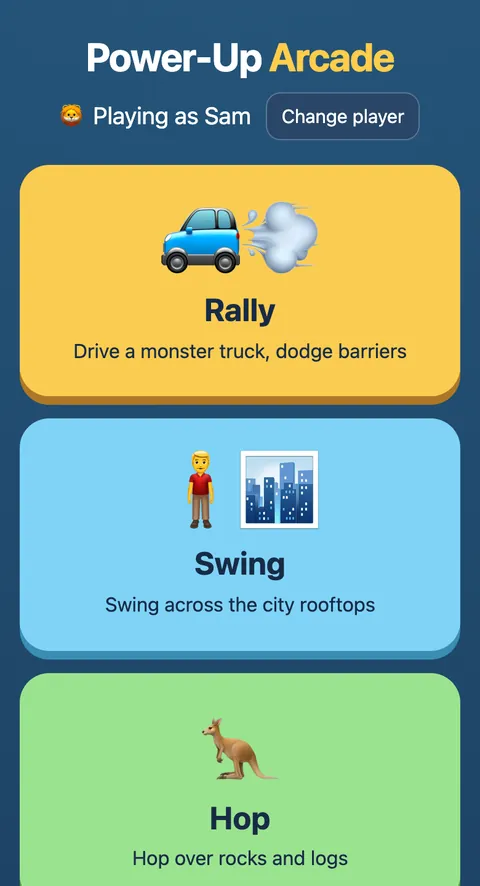
It is a menu of seventeen small games with math questions inside them: Rally, Swing, Penalty, Village Quests, Monster Maker and the rest. For a third grade year there are two things it does that I would otherwise be doing by hand.
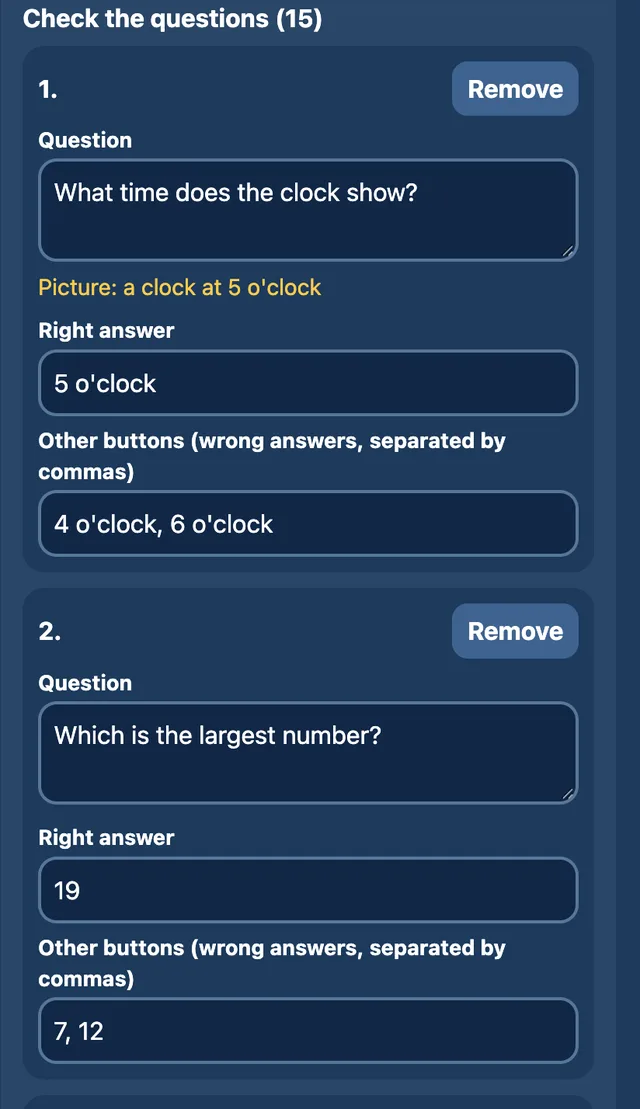
The first is choosing tonight's skill. You photograph the page that came home, one or two pages, and it will “make up to 15 practice questions that test the same thing with different numbers. You check them before your child plays.” I like that it takes the choosing off me: the questions come from the page that came home. The photos go to Anthropic, the AI provider that writes the questions, and are deleted once read.
The second is the index card job. “All the games share each player's practice, so questions come back when they're due in any of them”, so a fact missed in Penalty on Monday turns up in Rally on Thursday without anyone writing it down.
There is a goal setting worth using, and the strict counting is the part I would point at. A grown-up picks the reward, and the arcade says: “Only answers right first time count, starting now. Guessing until a button turns green doesn't move the bar.”
You can try it without paying anything. The free version gives you “a sample of 87 questions, saved on this device only”, which is enough evenings to see whether your child will sit with it, and the Family Plan “unlocks all 1260 questions, new ones made up as your child plays, and progress on every device”. If the worksheet is the part you care about, I wrote the whole method out in a separate guide, Turn Math Homework Into Practice Games, and it works app or no app.
Try tonight's ten minutes
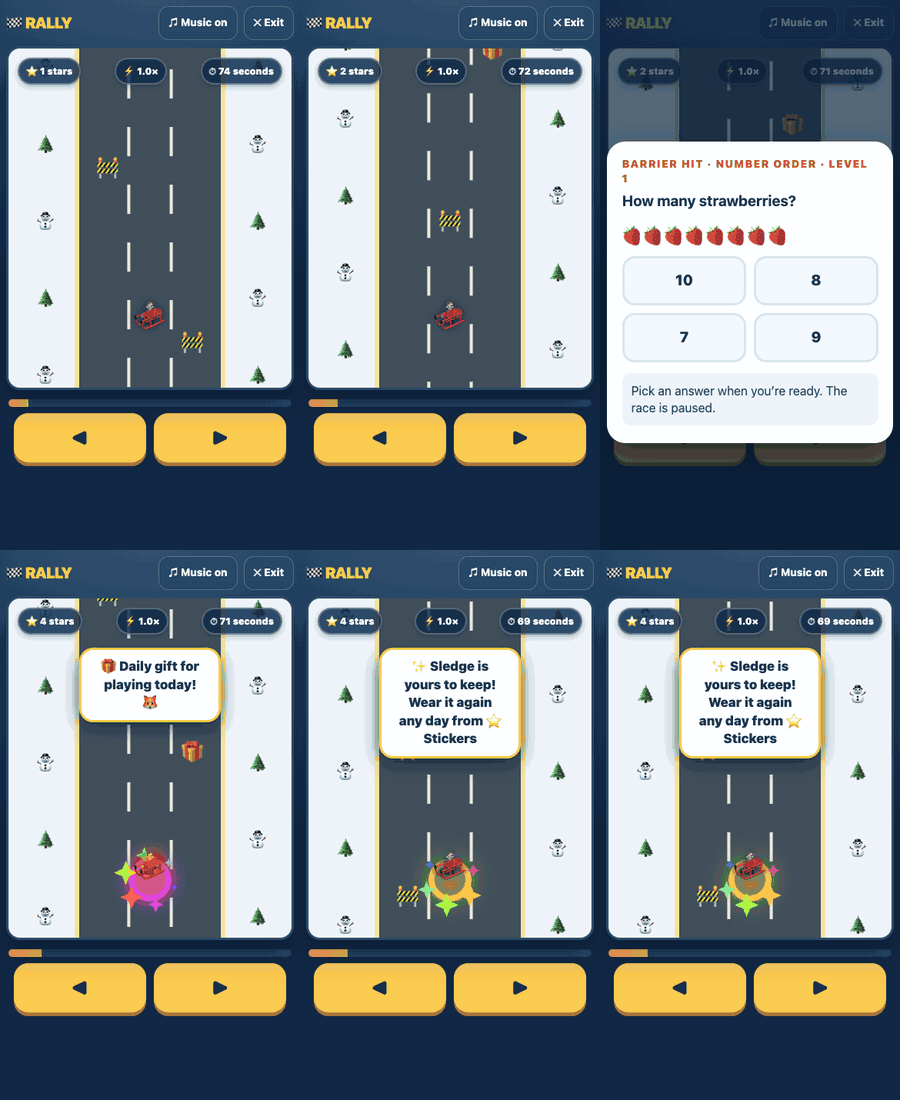
Add a player with a name, a picture and an age, pick the skill the teacher is working on, and sit with them for one round of something with a monster truck in it.
The free sample is 87 questions, saved on that device. The Family Plan gives you all 1260 questions on every device.
More about the arcadeWhen a game is not the answer
Games fix a practice-sized gap. They do not fix a missing foundation, and my advice is to check the rung below before you blame the times tables. If your child cannot add or subtract within twenty without counting, I would go back there first, whatever the game is like, and give it a few weeks. My guide to math games for 6 and 7 year olds covers that ground, and nobody at school needs to know.
The other thing a game cannot fix is a child who has decided they are bad at math. My own feeling is that ten more minutes of questions confirms that idea rather than changing it. Shrink the session to three minutes of things they can already do, for two weeks, and watch whether the shoulders come down before you add anything back. And if the gap has lasted a school year, that is a conversation with the teacher, with practice running alongside whatever they suggest.
Frequently asked questions
What math should a 3rd grader know?
By the end of third grade the standards expect fluent multiplication and division within 100, and “By the end of Grade 3, know from memory all products of two one-digit numbers”. Alongside that: fractions as numbers on a number line with denominators of 2, 3, 4, 6 and 8, the area of a rectangle found by multiplying its side lengths, rounding “to the nearest 10 or 100”, and adding and subtracting “within 1000”.
How do I help my 3rd grader learn the times tables?
Teach the two tricks before the drill. Commutativity first, because “If 6 × 4 = 24 is known, then 4 × 6 = 24 is also known”, so one fact hands your child the other. Then breaking apart: “Knowing that 8 × 5 = 40 and 8 × 2 = 16, one can find 8 × 7”. Drill after that, in short daily bursts, with multiplication war or a free tool like XtraMath.
What are the best math games for 3rd graders at home?
Match the game to the skill. Multiplication war with a deck of cards for the tables, graph paper and two dice for area, folded paper strips for fractions. On a screen, XtraMath for the facts drill and Khan Academy's 3rd grade math course, which lists 142 skills across 14 units, for filling gaps. The Power-Up Arcade is the one I would use when you want a homework page turned into the practice.
How do I teach fractions to a 3rd grader?
With objects before symbols. Fold paper strips into halves and quarters and let your child stack them to see the standard's own example, “1/2 = 2/4”. Third grade is the year a fraction becomes a number on the number line rather than a shaded shape, so draw a line from zero to one and mark the parts on it. Keep comparisons honest: they are “valid only when the two fractions refer to the same whole”.
Are free math games enough for 3rd grade?
For the drill, yes. XtraMath is free and asks for ten minutes a day, and Khan Academy's 3rd grade math course lists 142 skills across 14 units, paid for by donations rather than by families. What I still do myself with free tools is the choosing: which skill my child needs tonight, and what they got wrong two weeks ago. That is the part I would pay to have back.
How much math practice does a 3rd grader need at home?
Ten minutes on most days beats an hour at the weekend. When John Dunlosky and colleagues reviewed the ways children are asked to study in 2013, the two that came out best for learners of every age and ability were being tested on what you know, and spreading that practice across days rather than doing it all at once. Both halves of the ten minutes are in there. The practical reason counts too. A short session is easier to finish without a row, and finishing it is what buys you tomorrow's session.
My 3rd grader is behind in math. Where do I start?
Below where they are stuck, not at it. Check addition and subtraction within twenty first, and if that still needs fingers, start there for a few weeks. Then one table at a time, with the break-apart strategy taught rather than drilled. Tell the teacher what you are doing at home, and ask what they are seeing in class.