Short answer: split the ten minutes three ways. Two minutes on something your child can already do, five on the one skill they are working on now, three bringing back facts they missed last week. XtraMath offers to build math skills in “Just 10 Minutes a Day, for Free”, and a deck of cards will cover the rest. Our Power-Up Arcade is the one that takes a photo of tonight's marked worksheet and makes practice questions out of it, so the five minutes land on the exact thing the teacher is working on instead of on whatever the app had queued.
Why short and often beats long and occasional
This is the rare bit of parenting advice with real evidence behind it. In a 2013 review in Psychological Science in the Public Interest, John Dunlosky and colleagues reported that “Practice testing and distributed practice received high utility assessments because they benefit learners of different ages and abilities”. Both of those are what the ten minutes is made of. Your child is asked something and has to produce the answer, and it happens on a Monday and again on a Wednesday rather than all at once on a Sunday.
Treat that as a principle rather than a promise about any particular app. It is still enough to plan around, and what it says is that the ten minutes is the better shape, not a watered-down version of the hour.
There is a second reason, less scientific and more honest. A short session ends while your child still has some goodwill left. A long one ends in a fight, and the fight is what they remember when you suggest practice again on Thursday.
The ten-minute routine
Set a timer where your child can see it. The timer is doing a job of its own: it tells them this ends.
Two, five, three
Minutes one and two: the warm-up
Something they can already do, fast, with no help: counting in fives, or doubles to ten, or the two times table if that is solid. The point of it is starting with a win. A child who opens the session getting eight right in a row sits differently for the next bit.
Minutes three to seven: the rung
One skill. The one they cannot do smoothly yet, which is almost never the one on the front of the workbook. This is where the work happens and where the frustration lives, so it sits in the middle, protected on both sides.
Minutes eight to ten: the review
Questions they got wrong on an earlier night. Not today's. Last week's, or the week before. Most home practice skips this block entirely, and it is the block that decides whether anything from a month ago is still there.
Then stop, on the timer, even mid-roll. Ending while they still want one more is how you get tomorrow's session for free.
What to put in the warm-up
Pick something from last month that is now easy. For a five or six-year-old that is usually counting, or the small sums the standards call fluency “within 5”. For an older child it might be doubles, or counting back from a hundred in tens. Ask eight or ten of them quickly, in the car or on the stairs if you want, and let them be good at it.
Resist the urge to use the warm-up as extra practice on the hard thing. You will, the first few times. It costs you the session.
The five minutes that do the actual work
The hard part here is not the practice, it is knowing which skill to aim at. Grade level is a bad guide: plenty of second graders are fine with the second-grade work on paper and still counting on their fingers for sums they met in first grade. The first-grade standard asks children to “Add and subtract within 20, demonstrating fluency for addition and subtraction within 10”, and the second-grade one expects that “By end of Grade 2, know from memory all sums of two one-digit numbers.” Those two sentences are where most of the stalling happens, and a child can look fine on a worksheet while neither is true.
If you want help finding the rung, start with math learning games for kids. If you would rather not diagnose anything, use the worksheet that came home instead. The teacher already picked the skill.
Whatever you choose, keep it to one thing for the whole five minutes. Switching skills mid-block feels productive and teaches neither.
The review block, and why everybody skips it
A child gets eight plus seven wrong on Monday, you correct it, they get it right twice, and everyone moves on. By the following Wednesday it has gone again, and nobody finds out until it turns up in a test. The distributed practice half of the Dunlosky finding is exactly this: the same question has to come back later, when it has had time to fade a bit.
The free way to do it costs you an index card. Every time a question goes wrong, write it on the card. At the end of the week, the last three minutes of each session are the card. Right twice on separate nights, cross it off. It is clunky and it works, and it is also the single most-skipped thing in home math practice, because remembering what your child got wrong nine days ago is a job nobody wants.
Software is good at precisely that job. The Power-Up Arcade does it across the whole menu: “All the games share each player's practice, so questions come back when they're due in any of them.” A fact missed in Rally comes back in Penalty, and your child has no idea that is what happened. That is the honest version of what spaced review buys you: the questions are no cleverer, nothing just gets quietly dropped.
For the order to drill facts in, try math fact practice games.
Free games that fit the ten minutes
XtraMath, for the drill block
Built for exactly this shape. XtraMath's home page offers to “Build Essential Math Skills in Just 10 Minutes a Day, for Free”, and it was “Founded as a 501(c)3 non-profit in 2009”. One caution, which is the same thing that makes it effective: it measures speed. Its reports show “each student's accuracy, speed, and fluency level for every operation”. For a child still working every sum out, a clock is the wrong pressure. Save it for after the strategy is in place, when the job really is speed.
A deck of cards, for the strategy block
Take the face cards out, deal two, and your child says the total, or what the pair needs to make ten. For the five-minute block at the making-ten stage, no app can match it, because you can see the pause and the finger under the table. You know whether the answer came from memory or from counting. There is more for that age in math games for 6 and 7 year olds.
Khan Academy Kids, for the youngest
If your child is four to six and ten minutes of anything structured is a stretch, this is the one I would put on the tablet. Khan Academy Kids is built “for kids ages two to eight”, says “100% free - forever” with “No ads, no subscriptions”, and covers early reading alongside math.
To weigh up more of these products, try educational math games.
Where the Power-Up Arcade fits the routine
It is a menu of seventeen small games, Rally, Swing, Penalty, Village Quests, Monster Maker and the rest, with math questions inside them. For this routine it does two things free tools leave to you.
The first is the five-minute block. You photograph the page that came home, one or two pages, and it will “make up to 15 practice questions that test the same thing with different numbers. You check them before your child plays.” That is the shortcut past the whole diagnosis problem, because the skill was chosen by the person who teaches your child. The photos go to Anthropic, the AI provider that writes the questions, and are deleted once read.
The second is the three-minute block, which is the index card job done for you.
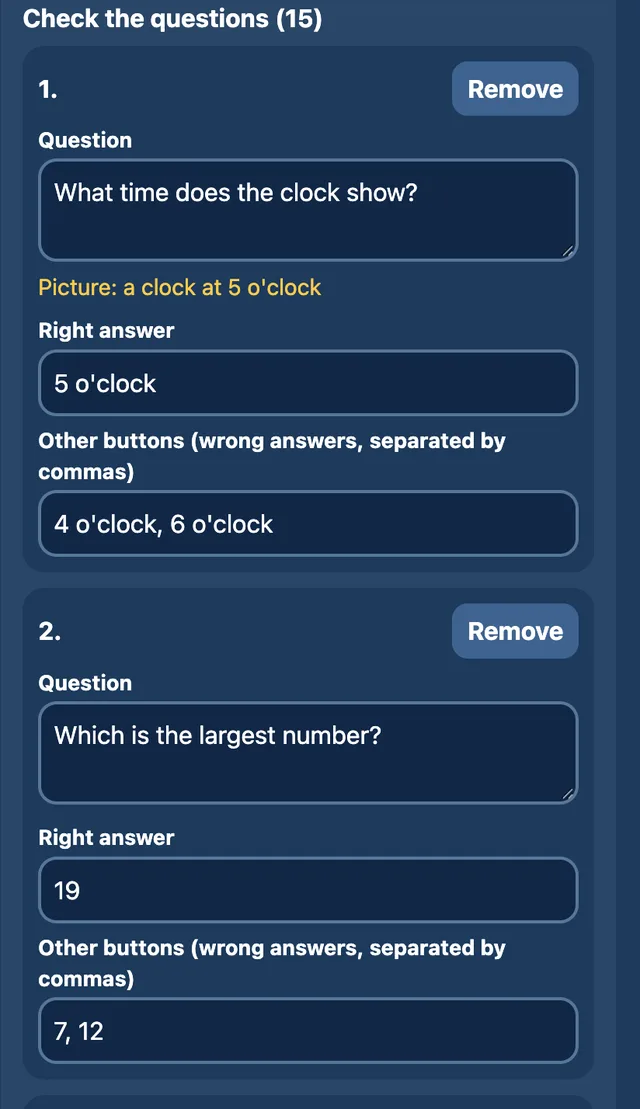
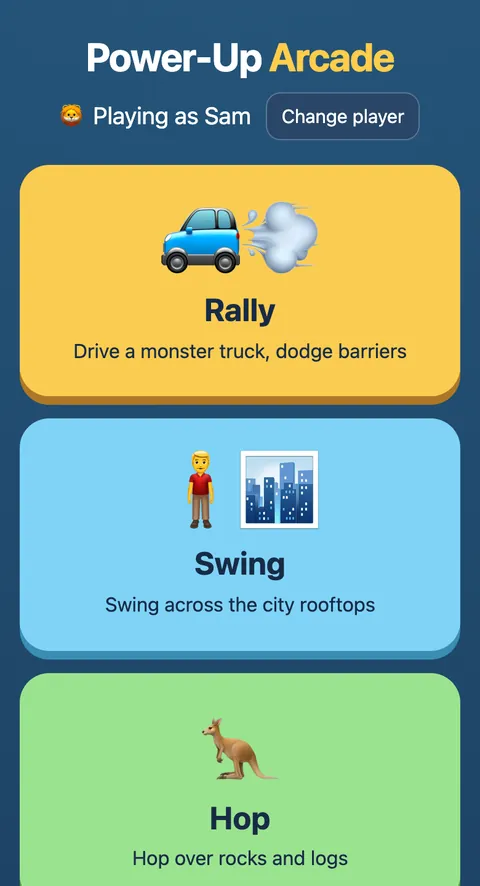

One more piece suits a nightly habit. A grown-up can set a goal with a reward attached, and the arcade counts it strictly: “Only answers right first time count, starting now. Guessing until a button turns green doesn't move the bar.” Children find the loophole in every reward chart within a week, and this one is closed.
Trying it costs nothing and gives you “a sample of 87 questions, saved on this device only”, which is several nights of the routine and plenty to see whether your child will sit with it. The Family Plan “unlocks all 1260 questions, new ones made up as your child plays, and progress on every device”.
Try tonight's ten minutes
Add a player with a name, a picture and an age, pick the skill you want, and sit with them for one round of something with a monster truck in it.
The free sample is 87 questions, saved on that device. The Family Plan gives you all 1260 questions on every device.
More about the arcadeWhen ten minutes is not the problem
The routine assumes your child will sit down. If the fight starts before the timer does, practice is not the thing to fix first. Usually what is underneath it is a child who has decided they are bad at math, and ten more minutes of being asked questions confirms it rather than changing it. Shrink the session to three minutes of things they can do, for two weeks, and see whether the shoulders come down.
The routine also assumes the gap is practice-sized. It will not teach a strategy nobody has shown your child yet. If making ten is missing, somebody has to sit down with real objects and show them that eight and six is eight and two and four, before any amount of drill will help. And if the gap has lasted a school year, or your child is counting on fingers for sums they met two grades ago, that is a conversation with the teacher, with the practice running alongside whatever they suggest.
If you would rather start from the homework page than from a routine, try turn math homework into practice games, or counting money games for coins.
Frequently asked questions
How long should a child practice math at home each day?
Ten minutes on most days beats an hour at the weekend, and the research reason is distributed practice. In their 2013 review, John Dunlosky and colleagues found that “Practice testing and distributed practice received high utility assessments because they benefit learners of different ages and abilities”. The practical reason matters just as much: a short session ends before anybody loses their temper, which is what buys you tomorrow's session.
What is the ten-minute math practice routine?
Two minutes on something your child can already do, five minutes on the one skill they are stuck on, and three minutes on questions they got wrong on an earlier night. Set a visible timer and stop when it goes, even mid-game. The warm-up starts them on a win, the middle block does the work, and the review block is what stops last month's learning quietly disappearing.
Which math skill should my child practice?
The first one they cannot do smoothly, which is usually below their grade level. First grade asks children to “Add and subtract within 20, demonstrating fluency for addition and subtraction within 10”, and by the end of second grade they should “know from memory all sums of two one-digit numbers”. If you would rather not work it out, use tonight's worksheet: the teacher has already chosen the skill.
Are free math practice games good enough?
For the drill, yes. XtraMath offers to “Build Essential Math Skills in Just 10 Minutes a Day, for Free” and was “Founded as a 501(c)3 non-profit in 2009”, and Khan Academy Kids is “100% free - forever” with “No ads, no subscriptions” for ages “two to eight”. What free tools generally leave to you is matching the questions to what your child is working on this week, and remembering what they got wrong two weeks ago.
How do I make sure my child does not forget what they practiced?
Bring the misses back later, on purpose. Write every wrong answer on an index card and spend the last three minutes of each session on the card, crossing items off after two correct answers on separate nights. Software can do the remembering instead: in the Power-Up Arcade “All the games share each player's practice, so questions come back when they're due in any of them”, so a fact missed in one game turns up in another.
Can a practice game use my child's actual homework?
The Power-Up Arcade is built for that. You photograph one or two pages and it will “make up to 15 practice questions that test the same thing with different numbers. You check them before your child plays”, so you see every question before your child does. The photos are sent to Anthropic, the AI provider, and deleted once read.
What if my child refuses to practice at all?
Make the session smaller than the resistance. Three minutes of questions they can already answer, for a couple of weeks, with no new skill in it at all. You are rebuilding the idea that math is something they can be good at, and until that is back, extra practice tends to prove the opposite point.