Short answer: the game matters less than the match. Find the first skill on the checklist your child cannot do smoothly, then pick anything that asks that question often and marks it straight away. For counting and cardinality a young child needs objects and a grown-up more than an app. For number facts almost any drill-shaped game works, free ones included. For the gap between the two, making ten, a deck of cards is still hard to beat. And for the worksheet that came home today, our own Power-Up Arcade makes up to 15 practice questions that test the same thing with different numbers, inside the games.
Real skills have names, and the standards print them
Ask a parent what their second grader needs to work on and the answer is usually “math”, or “times tables” a year before times tables are the issue. The curriculum is more specific than that, and the specificity is what lets you judge a game in a minute.
The K to 2nd grade skills checklist
Print it, or keep it on your phone. Work down it until you hit something your child cannot do without a long pause. That is the rung, and that is what a game should be practising.
Kindergarten
- Count to a hundred. The standard (K.CC.A.1) asks them to “Count to 100 by ones and by tens.”
- The last number said is how many. K.CC.B.4 calls it connecting counting to cardinality. Count seven buttons, then ask how many there are. A child who recounts has not got it yet, and this one matters more than anything else on the page.
- Break a number apart more than one way. K.OA.A.3: “Decompose numbers less than or equal to 10 into pairs in more than one way.” Five is four and one, and three and two.
- Small sums without counting. K.OA.A.5: “Fluently add and subtract within 5.”
First grade
- Count on from anywhere. 1.NBT.A.1: “Count to 120, starting at any number less than 120.” Starting at one every time is the tell.
- Tens and ones. 1.NBT.B.2 asks them to understand “that the two digits of a two-digit number represent amounts of tens and ones.”
- Making ten. 1.OA.C.6: “Add and subtract within 20, demonstrating fluency for addition and subtraction within 10”, using strategies including “making ten (e.g., 8 + 6 = 8 + 2 + 4 = 10 + 4 = 14)”. This is the rung I have watched children stall on longest, and the one I would spend the practice on.
- The missing number. 1.OA.D.8 asks them to find what makes the equation true in “8 + ? = 11”. Subtraction wearing a different coat.
Second grade
- Facts from memory. 2.OA.B.2: “Fluently add and subtract within 20 using mental strategies. By end of Grade 2, know from memory all sums of two one-digit numbers.” Memory, not working it out quickly.
- Bigger numbers, same confidence. 2.NBT.B.5: “Fluently add and subtract within 100 using strategies based on place value.”
- Skip counting. 2.NBT.A.2: “Count within 1000; skip-count by 5s, 10s, and 100s.” The quiet start of multiplication.
- Clocks and coins. 2.MD.C.7 asks them to tell and write time “to the nearest five minutes, using a.m. and p.m.”, and 2.MD.C.8 to solve money problems “using $ and ¢ symbols appropriately”.
Nobody is behind for failing one of these in the first month of the school year. The list is for finding where to aim, not for grading your child.
Four questions that find the rung
You do not need a worksheet for this, and it goes better in the car than at a desk. Ask these, and pay attention to how the answer arrives rather than whether it is right. Fingers under the table, a long silence, or a restart from one all count as not yet.
- “Start at forty-seven and keep counting for me.” Smooth across the next ten is the first-grade counting rung.
- “What goes with seven to make ten?” Instant means making ten is there. Counting up on fingers means you have found tonight's practice.
- “Eight plus what makes eleven?” The missing-number shape. Children who are fine with eight plus three often stall here, which is useful to know.
- “You have two dimes and three pennies. How many cents?” Skip counting and coins in one question, straight out of the second-grade standard.
Whichever one goes wobbly first is the one to practise, and now the game has a job to do.
Matching a game to the rung
The counting rung: fewer screens than you would think
Cardinality, one-to-one counting and taking five apart went better in our house with objects and a
grown-up than with anything on a screen. Buttons, pasta, stair steps on the way up to bed. If you want a screen in the mix for a four to
six-year-old, Khan Academy Kids is the one I would put on a tablet first: it is built “for kids ages
two to eight”, it says “100% free - forever” with “No ads, no subscriptions”,
and it covers early reading alongside math.
khanacademy.org/kids
Math games for kindergarten goes further into what helps at five, including the counting gap most of us miss because a child who can chant to twenty sounds like a child who can count.
The making-ten rung: cards beat apps here
This is the rung where a game earns its keep, and where the best one costs nothing. Pull the face cards out of a deck, deal two, and the child says what the pair needs to reach ten. Your advantage over any app is that you can see the pause and the finger, so you know whether the answer came from memory or from counting. Math games for 6 and 7 year olds has the version we played at home.
The from-memory rung: drill, cheerfully
Once the strategies are in place, the job is repetition, and a game is the easiest way to make repetition
bearable. XtraMath is the best free thing aimed squarely at it, “Founded as a 501(c)3 non-profit in
2009” and offering to “Build Essential Math Skills in Just 10 Minutes a Day, for Free.”
The caution is the same thing that makes it work: it tracks speed, which lands badly on a child still
working every answer out. Save it for after the strategies.
xtramath.org
The ladder of which facts to drill, and in what order, is in math fact practice games. A fuller comparison of five of these products, and a three-minute test you can run on any of them, is in educational math games.
Why practice inside a game works at all
The game is not the active ingredient. Being asked something, answering it, and finding out immediately
whether you were right is the ingredient. In a 2013 review in Psychological Science in the Public
Interest, John Dunlosky and colleagues rated ten common study techniques and reported that
“Practice testing and distributed practice received high utility assessments because they benefit
learners of different ages and abilities and have been shown to boost students’ performance across
many criterion tasks and even in educational contexts.” That work looked at studying across many ages
rather than at math apps, so take it as a principle rather than a promise about any product.
Dunlosky et al., Psychological Science in the Public Interest
It does point at the two things worth insisting on, though. Plenty of questions, and the same question coming back another day rather than disappearing after one miss.
What the Power-Up Arcade is for
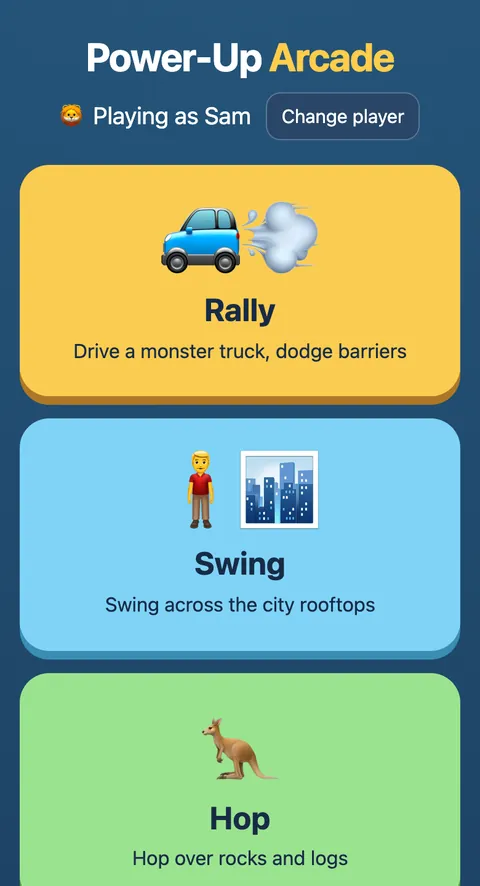
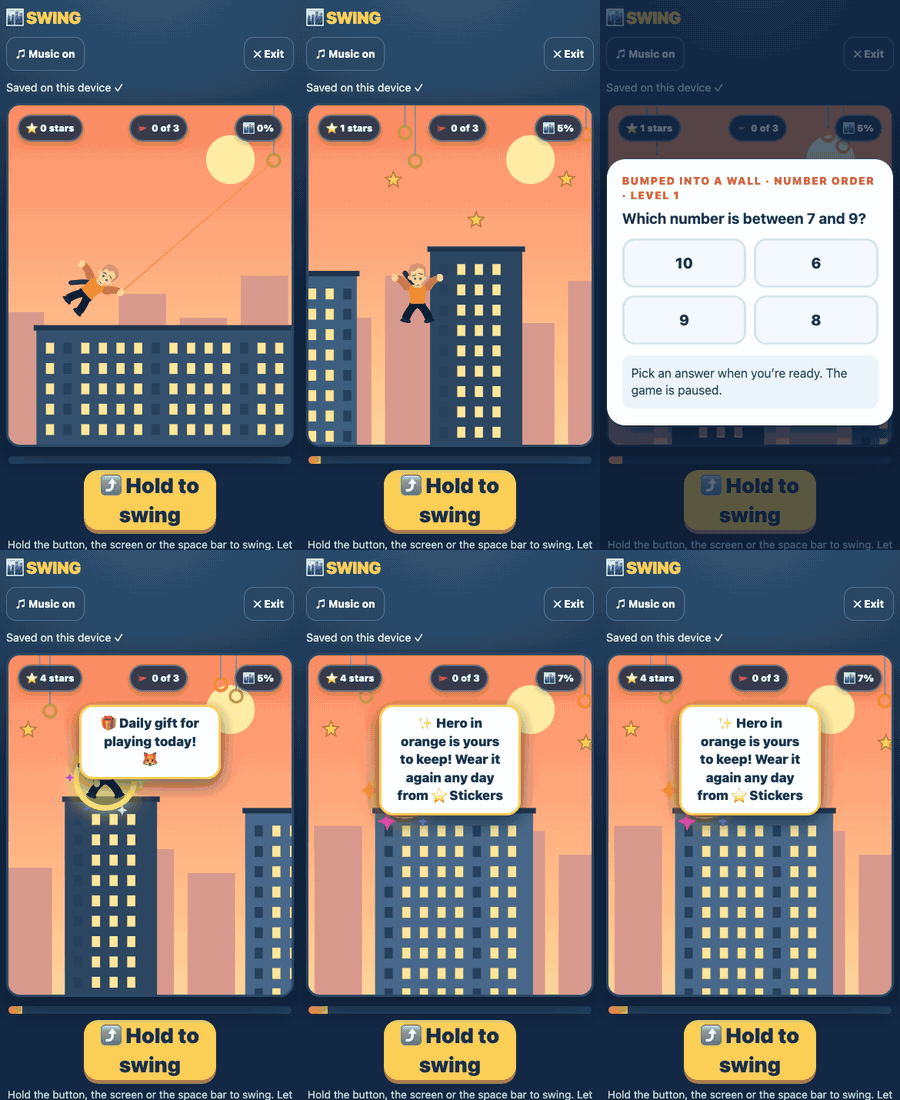
The Power-Up Arcade is a menu of seventeen small games, Rally, Swing, Penalty, Village Quests, Monster Maker and the rest, with questions inside them. The design decision that matters for the ladder above is this one, in its own words: “All the games share each player's practice, so questions come back when they're due in any of them.” A fact missed in the racing game turns up again in the penalty game.
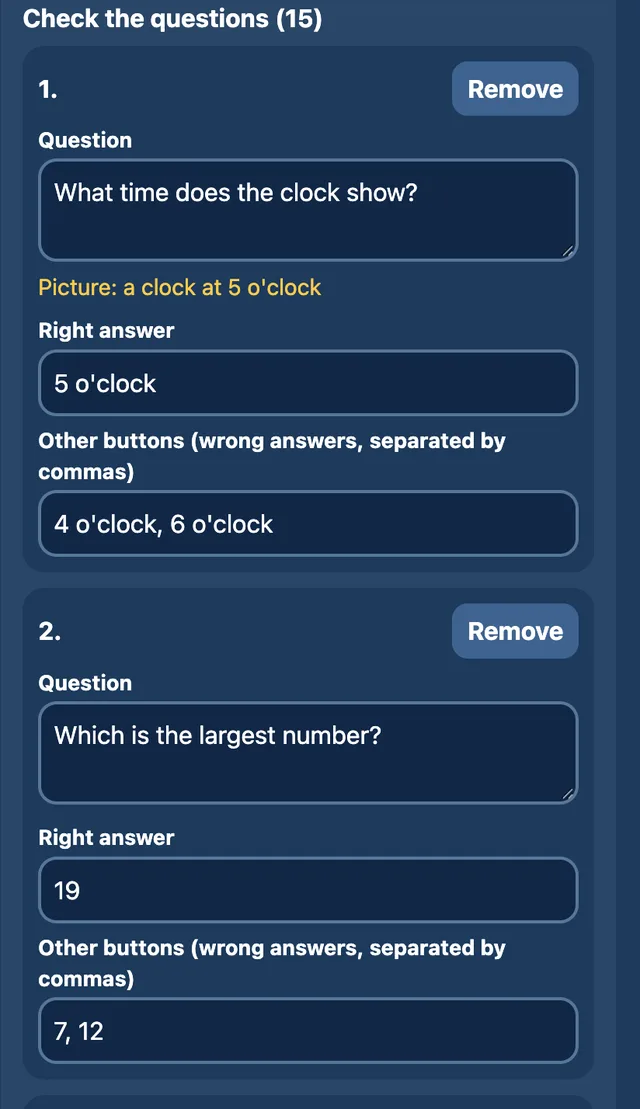
The feature parents keep using is the worksheet photo. You photograph the page that came home on Monday and it will “make up to 15 practice questions that test the same thing with different numbers. You check them before your child plays.” That is the shortcut to the rung, because the teacher has already chosen it for you.
What it is not: a reading app, a teacher, or something that will hold a four-year-old the way Khan Academy Kids does. Trying it costs nothing and gives you “a sample of 87 questions, saved on this device only”, which is plenty to see whether your child will sit with it. The Family Plan “unlocks all 1260 questions, new ones made up as your child plays, and progress on every device”.
Try it on tonight's rung
Add a player with a name, a picture and an age from four to twelve, pick the skill you found on the checklist, and sit with them for one round.
The free sample is 87 questions, saved on that device. The Family Plan gives you all 1260 questions on every device.
How the arcade works →What no game will do for you
It will not teach a strategy your child has never been shown. If making ten is missing, somebody has to sit down and show them that eight and six is eight and two and four, with objects, before any app can drill it. In our experience, no app yet tells you why a child is stuck; that remains the teacher's ground. And it will not notice that the real problem is that your child has decided they are bad at math, which is a different conversation and usually a more important one.
Used for the narrow job, though, a game is genuinely good: it makes the same question come back, often enough and cheerfully enough that your child does not fight you about it. If the questions you want are the ones already in the schoolbag, the method for that is in turn math homework into practice games, and counting money games does the coins rung with real coins.
Frequently asked questions
What are math learning games?
Any game, on a screen or at the kitchen table, whose point is practice rather than scenery. The useful ones aim at a named skill. In the Common Core sequence that skill is a specific thing at each age: kindergarten is asked to “Fluently add and subtract within 5”, first grade to “Add and subtract within 20, demonstrating fluency for addition and subtraction within 10”, and second grade to “know from memory all sums of two one-digit numbers”. A game that is not aimed at the rung your child is on is a nice way to pass a Sunday, not practice.
Which math skills should my child have in kindergarten, first and second grade?
The Common Core standards name them plainly. Kindergarten: “Count to 100 by ones and by tens”, connect counting to cardinality, “Decompose numbers less than or equal to 10 into pairs in more than one way”, and “Fluently add and subtract within 5”. First grade: “Count to 120, starting at any number less than 120”, understand that the two digits of a two-digit number represent tens and ones, add and subtract within 20 with fluency within 10, and find the missing number in “8 + ? = 11”. Second grade: know from memory all sums of two one-digit numbers, “Fluently add and subtract within 100”, “Count within 1000; skip-count by 5s, 10s, and 100s”, and tell time “to the nearest five minutes”. Your state may word these differently, so treat it as the ladder rather than the law.
How do I know which math skill my child needs to practise?
Ask four questions in the car or at breakfast and listen to how the answers arrive, not just whether they are right. Start at forty-seven and keep counting. What goes with seven to make ten? Eight plus what makes eleven? You have two dimes and three pennies, how many cents? A long pause, fingers under the table, or a restart from one tells you the rung. The first one they cannot do smoothly is the one worth practising.
Do math learning games actually build skills?
The practice inside the game does, and the game is what makes a child willing to do it. In their 2013 review in Psychological Science in the Public Interest, John Dunlosky and colleagues rated ten study techniques and found that “Practice testing and distributed practice received high utility assessments because they benefit learners of different ages and abilities”. That review covered studying across many ages rather than math apps, so treat it as a principle. A game that asks plenty of questions and brings missed ones back is running that method. One that mostly rewards tapping is not.
What are the best free math learning games for kids?
For a four to six-year-old, Khan Academy Kids, built “for kids ages two to eight” and “100% free - forever” with “No ads, no subscriptions”. For number facts at any age, XtraMath, “Founded as a 501(c)3 non-profit in 2009”, which offers to “Build Essential Math Skills in Just 10 Minutes a Day, for Free”. For the making-ten rung, a deck of cards beats both, because you can see your child’s face while they think.
How much time on a math game is enough?
Short and most days beats long and occasional, which is the distributed practice half of the Dunlosky finding. Stop while your child still wants one more round. A session that ends in an argument costs you tomorrow’s session as well, and the skill needs tomorrow more than it needed the extra ten minutes tonight.
My child is behind. Is a game enough to catch up?
A game is good at one job: making the same question come back often enough to stick. It cannot teach a strategy your child has never been shown, spot a specific misconception, or tell you whether something else is going on. If the gap has lasted a school year, or your child is counting on fingers for sums they met two grades ago, talk to the teacher and use the game alongside what they suggest.