Short answer: work out which of the four skills is weak, then pick the game for that one. Target One Thousand with a deck of cards for two-digit multiplication. Leftovers with a die and a pile of counters for division, because remainders are the part fourth grade adds. A supermarket receipt for decimals, and a quick card game against a half for fractions. On a screen, Khan Academy's fourth grade course runs to 14 units. Our Power-Up Arcade is the one I reach for when I want tonight's actual worksheet to become the practice: photograph the page and it will “make up to 15 practice questions that test the same thing with different numbers”, so the choosing is done for me.
What fourth grade math actually asks for
Four skills, and they arrive close together, which is half the trouble.
Multiplication with bigger numbers. The fourth grade standard asks children to “Multiply a whole number of up to four digits by a one-digit whole number, and multiply two two-digit numbers, using strategies based on place value and the properties of operations”. Two two-digit numbers is the jump. My view is that a child who still works out 7 × 8 by counting has little attention left for 62 × 34, however neat their written layout is.
Division, with remainders. Fourth graders “Find whole-number quotients and remainders with up to four-digit dividends and one-digit divisors”. The remainder is the new idea here. The remainder is what I would spend the evening on, and I find counters on a table explain it better than a page of long division does.
Equivalent fractions, and comparing them. This is the year fractions stop matching. The fraction standards ask children to “Explain why a fraction a/b is equivalent to a fraction (n × a)/(n × b)… with attention to how the number and size of the parts differ even though the two fractions themselves are the same size”, and then to compare two fractions with different numerators and different denominators, “e.g., by creating common denominators or numerators, or by comparing to a benchmark fraction such as 1/2”. Grade four widens the denominators your child will meet to 2, 3, 4, 5, 6, 8, 10, 12 and 100.
Decimals, which are fractions in disguise. Fourth grade asks children to “Use decimal notation for fractions with denominators 10 or 100”, with the standard's own example being to “rewrite 0.62 as 62/100”, and to “Compare two decimals to hundredths by reasoning about their size”. There is a neat bridge in there too: express 3/10 as 30/100, and then “3/10 + 4/100 = 34/100”.
Around those four sit two housekeeping jobs. Children “Use place value understanding to round multi-digit whole numbers to any place” and “Fluently add and subtract multi-digit whole numbers using the standard algorithm”, with grade four expectations in that domain “limited to whole numbers less than or equal to 1,000,000”. If your child has gone wobbly on written addition, I would spend an evening there before touching anything harder.
Why fractions and division are the two to protect
If you only have the energy to guard two of the four this year, guard those. In 2012 Robert Siegler and colleagues published a study in Psychological Science using large national data sets from the United States and the United Kingdom. They reported that “elementary school students' knowledge of fractions and of division uniquely predicts those students' knowledge of algebra and overall mathematics achievement in high school, 5 or 6 years later”, and that the link held “even after statistically controlling for other types of mathematical knowledge, general intellectual ability, working memory, and family income and education”.
A prediction is not a promise, and one study settles nothing on its own. The practical version is narrower: when fourth grade fractions go badly, slow down that week rather than push through, because the same ground comes back every year afterwards.
Four games, one per skill, and one for the gaps
Four of them run at a table with cards, a die or an old receipt. The fifth is on a screen, for the evenings when you want to find a gap rather than practice a skill.
1. Target One Thousand, for two-digit multiplication
Take the face cards and the tens out of a deck and deal four of what is left to each player. Arrange your four into a two-digit times a two-digit problem, work it out, and whoever lands closest to one thousand wins the round. Aces are one.
The thinking happens before the arithmetic, which is why I like it. Your child has to work out which way round their four cards make the bigger product, and what I notice is that they start estimating on purpose after a few rounds instead of multiplying everything out and hoping. Keep a pencil and paper beside them for the working. If the tables underneath are still shaky, I would go there first, and my guide to math fact practice games has the order I would drill them in.
2. Leftovers, for division with remainders
You need a die and a bowl of small objects. Pasta works. Pennies work. Take a handful, count them out loud, then roll the die: that is how many equal piles to share them into. Share them out, and every object left over is yours to keep. We play to whoever collects the most leftovers before the bowl runs out.
Children chase the remainder, and that changes what a leftover means. Instead of looking like a mistake it becomes the thing worth having, so your child starts hunting for divisions that produce one. Say the whole sentence out loud each time, leftover included, rather than just the answer. Once a remainder means something physical, I find the written method reads as bookkeeping rather than magic.
3. Half or more, for comparing fractions
Write a fraction on each of a handful of index cards, using the fourth grade denominators: halves, thirds, quarters, fifths, sixths, eighths, tenths and twelfths. Shuffle them, deal one each, and the bigger fraction wins the pair. No common denominators allowed, no calculating. Your child has to argue for their card.
The one trick to teach before you start is the benchmark the standards name, “comparing to a benchmark fraction such as 1/2”: is the top number more or less than half the bottom one? I like it because it gives your child something to say out loud, which is what the standard is asking for when it wants comparisons justified. Keep the pairs honest as well: the standards are blunt that comparisons are “valid only when the two fractions refer to the same whole”.
4. The receipt game, for decimals
Keep the next supermarket receipt. It is the decimals practice I reach for most often at home, and it takes about as long as clearing the table:
Round one, find the most expensive item and the cheapest. Round two, pick two prices and have your child say which is bigger and why, which is “Compare two decimals to hundredths by reasoning about their size” with the reasoning said out loud. Round three is the one that teaches most: pick any price in cents and ask what fraction of a dollar it is. The standards use the same move, asking children to “rewrite 0.62 as 62/100”. Writing the same amount two ways is the part I would keep coming back to, and a receipt makes it feel more real than a worksheet does. There is more of this, built around coins, in counting money games for kids.
5. Khan Academy's fourth grade course, for the gaps
When you need to find a hole rather than practice a skill, this is where I would start. Khan Academy's 4th grade math lists 154 skills across 14 units, running from “Place value” at Unit 1 through “Multiply by 2-digit numbers” at Unit 4, “Division” at Unit 5, “Equivalent fractions and comparing fractions” at Unit 7 and “Understand decimals” at Unit 10. Khan Academy's own line on the page is “Free to use. Not free to make.”
Use the unit list as a checklist rather than a course. Open the unit your child is on, and if the first exercise goes badly, work backwards until you find one they can do. That is the unit I would work from, and in my experience it sits lower down the list than the homework would suggest.
The ten-minute check that finds the weak skill
Before you buy or play anything, find out which of the four is missing. Four questions, one per skill, on a blank page. Sit next to your child and watch how they answer rather than whether they get it right.
1. Write 62 × 34
Watch for the tables. If they pause on 6 × 4, the problem is third grade facts and no amount of long multiplication practice will fix it.
2. Write 154 ÷ 6
Watch what they do with the 4 left over. A child who ignores it, or writes twenty-five and stops, has not been taught the remainder, and that is an evening with a bowl of pasta rather than a term of worksheets.
3. Ask: which is bigger, 3/5 or 5/8?
Listen to the reason, not the answer. Comparing both to a benchmark such as 1/2 is the move the standards name. Cross-multiplying without knowing why is the answer I would follow up, because the reasoning is the part the standard asks for.
4. Ask: what is 0.7 as a fraction? And 0.07?
This one is about place value. Seven tenths and seven hundredths are different numbers, and a child who gives the same answer twice is the child I would spend the week with.
Whichever question went worst, that is the game I would play next. One skill at a time, a short sitting most evenings, and leave the other three alone until it moves.
Where the Power-Up Arcade fits a fourth grader
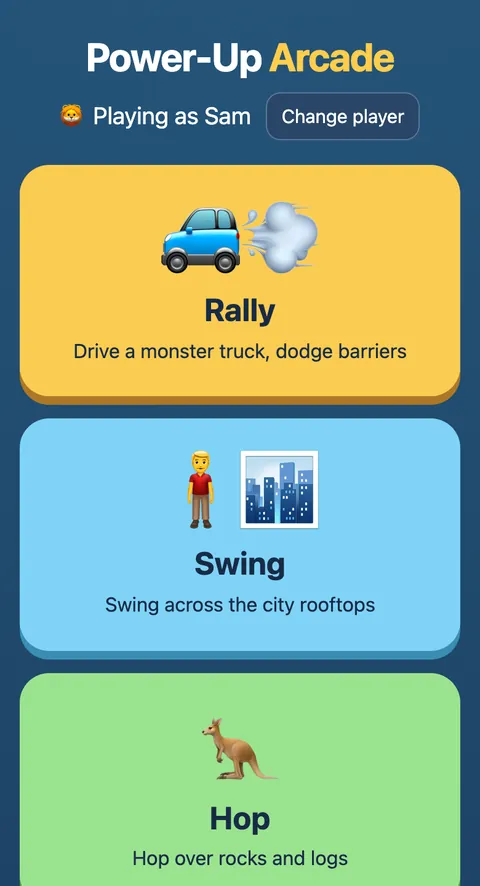
Seventeen small games with the math questions tucked inside them: Rally, Swing, Penalty, Village Quests, Monster Maker and the others. There are two things I stopped doing by hand once we had it, both of which used to live on an index card.
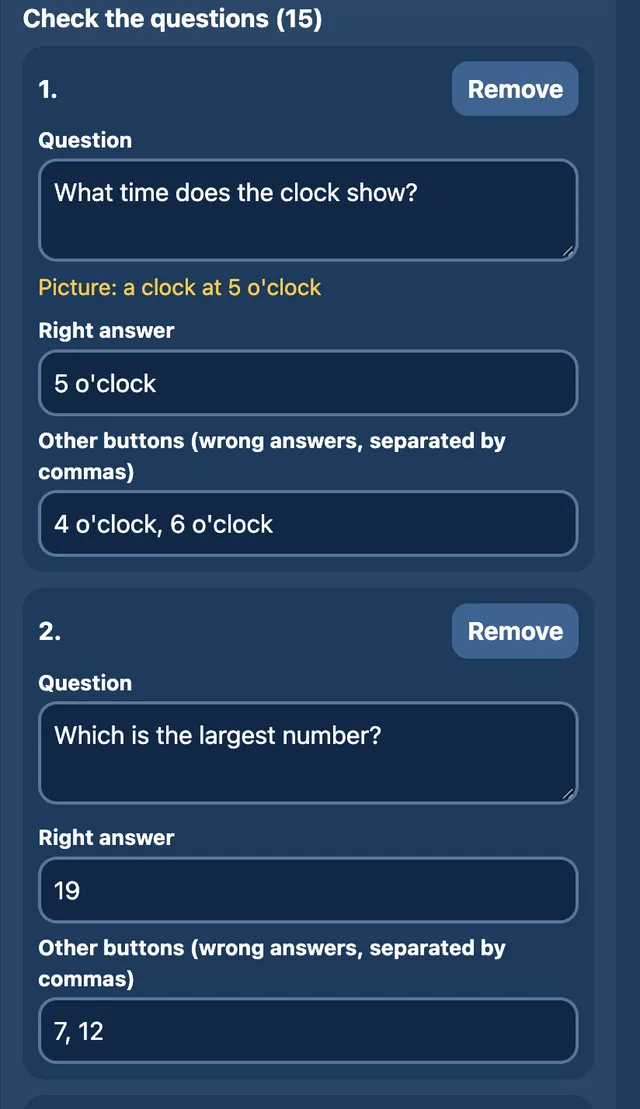
The first is aiming the practice at this week's work. You photograph the page that came home, one or two pages, and it will “make up to 15 practice questions that test the same thing with different numbers. You check them before your child plays.” That is the part I value, because the four skills come round in turn through the year and I kept finding an app parked on a different one from the teacher. The photos go to Anthropic, the AI provider that writes the questions, and are deleted once read.
The second is remembering what went wrong. “All the games share each player's practice, so questions come back when they're due in any of them”, so a remainder missed in Penalty on Monday turns up again in Rally on Thursday without anyone keeping a list.
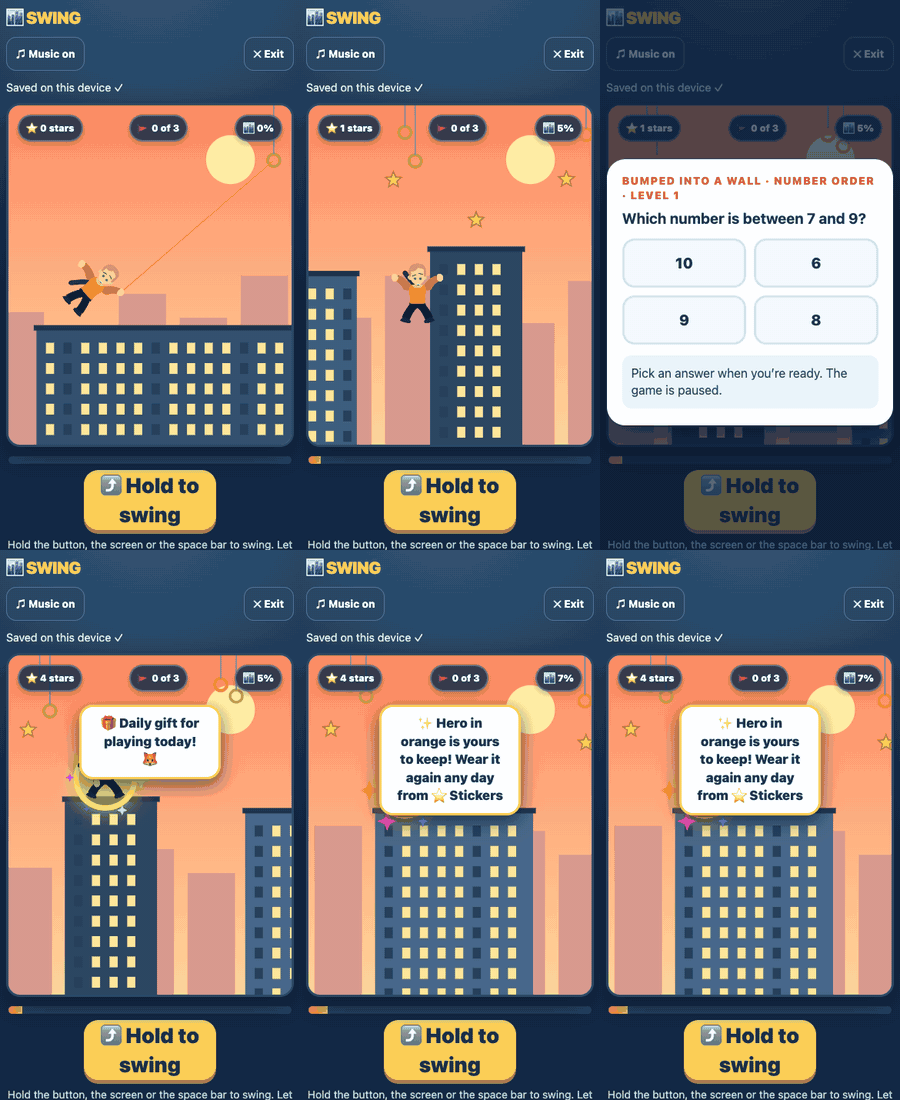
The goal setting is worth switching on at this age, mostly because of how strictly it counts. A grown-up picks the reward, and the arcade says: “Only answers right first time count, starting now. Guessing until a button turns green doesn't move the bar.” My own experience is that a child this age finds the shortcut in any app you hand them, so a bar that refuses to budge for a guess is doing real work.
Nothing has to be paid for to see whether your child will sit with it. The free version gives you “a sample of 87 questions, saved on this device only”, and the Family Plan “unlocks all 1260 questions, new ones made up as your child plays, and progress on every device”. If the worksheet is the part you care about, the method is written out in full in Turn Math Homework Into Practice Games, and it works with or without an app.
If you want to try the arcade
I would start with whichever of the four skills came out worst in the check above, and sit through the first round alongside your child.
Free is a sample of 87 questions on one device. The Family Plan gives you all 1260 questions, with progress on every device.
More about the arcadeWhen a game is not the answer
A game is practice, and practice is not the same as a missing foundation. The one I would check first in fourth grade is the times tables. Two-digit multiplication uses them several times in a row, and division asks for the same facts the other way round, so a child who is still counting up in sevens is working uphill on two of the four skills. I would go back a rung before going on, and math games for 3rd graders is where I would start.
The other thing a game cannot fix is a child who has decided they are bad at math, and this is about the age I have heard that said out loud. My own feeling is that more questions confirm the idea rather than shifting it. What I would do instead is shrink the session right down to things they can already do, hold it there for a couple of weeks, and watch whether the shoulders come down before adding anything back. A gap that has lasted the whole school year is a conversation with the teacher, with practice running alongside whatever they suggest. For a steadier weekly rhythm once things are moving again, there is math practice games, and if you are weighing up paid apps, IXL alternatives for kids checks the main ones.
Frequently asked questions
What math should a 4th grader know?
Four things carry the year: multiplying “a whole number of up to four digits by a one-digit whole number, and… two two-digit numbers”, finding “whole-number quotients and remainders with up to four-digit dividends and one-digit divisors”, generating and comparing equivalent fractions including “comparing to a benchmark fraction such as 1/2”, and using “decimal notation for fractions with denominators 10 or 100”. Alongside those, fourth graders round multi-digit whole numbers to any place and add and subtract them using the standard algorithm.
What are the best math games for 4th graders at home?
Match the game to the skill. Target One Thousand with a deck of cards for two-digit multiplication, Leftovers with a die and a pile of counters for division with remainders, a half or more card game for comparing fractions, and a supermarket receipt for decimals. On a screen, Khan Academy's fourth grade math course lists 154 skills across 14 units. The Power-Up Arcade is the one I reach for when I want tonight's worksheet turned into the practice.
How do I help my 4th grader with long division?
Start with the remainder rather than the algorithm. The standard asks for “whole-number quotients and remainders with up to four-digit dividends and one-digit divisors”, and the remainder is the new idea, not the layout. Share counters into equal piles and let your child keep the ones left over. Once a remainder means something physical, the written method stops being magic and becomes bookkeeping.
Why does my 4th grader struggle with fractions?
In my experience it is because this is the year fractions stop looking alike. The standards ask children to explain why a/b is equivalent to (n × a)/(n × b), “with attention to how the number and size of the parts differ even though the two fractions themselves are the same size”, and to compare fractions with different numerators and different denominators. Comparing to a half is the move I would teach first, and it is the one the standards name.
Are free math games enough for 4th grade?
For the practice itself, I think so. Khan Academy's fourth grade math course lists 154 skills across 14 units, from place value at Unit 1 through division at Unit 5 and decimals at Unit 10, and Khan Academy says on the page that it is free to use. What I still end up doing myself with free tools is the choosing: which skill my child needs tonight, and what they got wrong the week before last. That is the part I would pay to have back.
Do fractions in 4th grade really matter later?
More than I expected before I read the research on it. Robert Siegler and colleagues, writing in Psychological Science in 2012, found that “elementary school students' knowledge of fractions and of division uniquely predicts those students' knowledge of algebra and overall mathematics achievement in high school, 5 or 6 years later”, and that this held after controlling for other mathematical knowledge, general intellectual ability, working memory and family income and education. It is a prediction rather than a guarantee, but it is a good reason to slow down on a bad fractions week instead of pushing through it.
My 4th grader is behind in math. Where do I start?
Lower down than the homework suggests. Two-digit multiplication uses the times tables several times over and division asks for the same facts the other way round, so if the tables are not in memory, that is where I would start. Check that rung first, tell the teacher what you are doing at home, and keep the sessions short enough that your child finishes them.