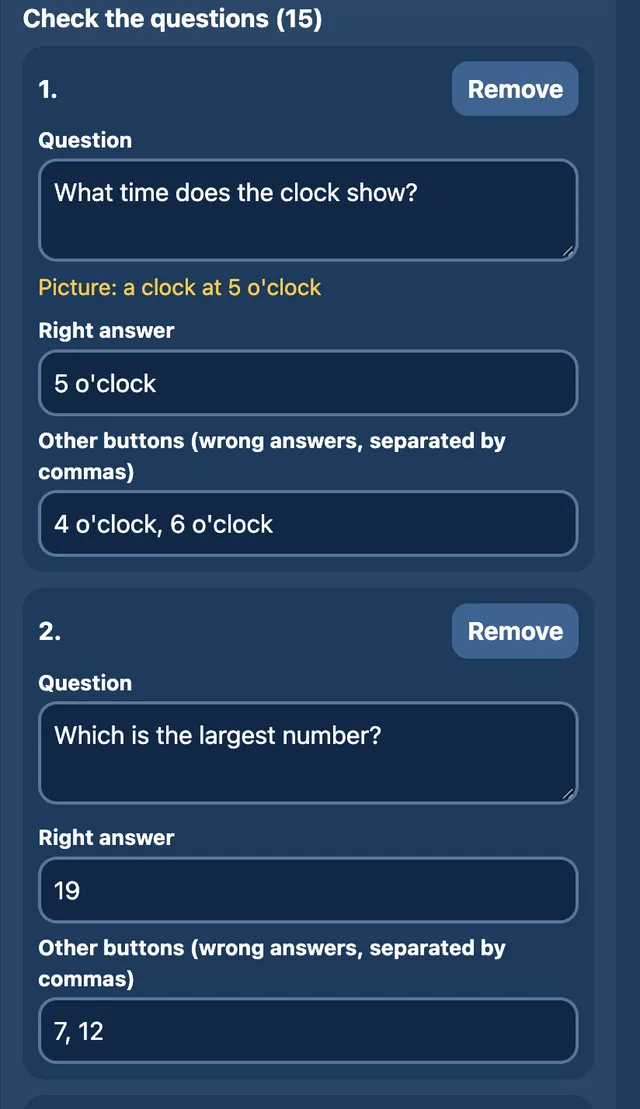
Short answer: teach it in four steps and never out of order. First o'clock, then half past, then quarter past and quarter to, then the five-minute jumps. Keep each step to short goes, spread out, rather than one long lesson. On Toy Theater's interactive clock you can “drag the hour and minute hands around the clock to adjust the time” and turn the digital clock on or off. On Topmarks' Teaching Clock each clock “can be set to show the current time, a random time according to various step options, or any given am or pm time”. And in our Power-Up Arcade you photograph the homework page itself: it will “make up to 15 practice questions that test the same thing with different numbers”, and “You check them before your child plays.”
Why a child who reads a phone cannot read a clock
It helps to name the actual difficulty out loud. Mathnasium's tutors put it plainly: the clock face “asks children to track two hands of different lengths, moving at different speeds, across two separate scales, all at once. That is a real cognitive load.”
The hour hand is “the short, slow-moving hand that points to the current hour”. The minute hand is “the long, faster-moving hand that counts the minutes”, and for that hand “Each number on the clock face represents a five-minute interval”. So the 3 is fifteen minutes for one hand and three o'clock for the other. For a while your child will read whichever number their eye lands on first.
This next one is worth saying out loud on the first day. The hour hand “may sit slightly past a number; that is normal, it has been moving since the last hour”, and at half past it “will never sit exactly on a number”. So give your child SplashLearn's version of the rule: “If the hour hand has just crossed a number, we read that number to know what hour it is”.
What school expects, and when
Worth knowing before you panic, because the clock arrives in three stages across three school years rather than all at once.
In first grade, the standard asks children to “Tell and write time in hours and half-hours using analog and digital clocks”. In second grade it moves on to “Tell and write time from analog and digital clocks to the nearest five minutes, using a.m. and p.m.” Third grade is where every minute counts: “Tell and write time to the nearest minute and measure time intervals in minutes”, and the same standard goes on to word problems about adding and subtracting those intervals.
If the kitchen table has turned frustrating, check whether the practice has run ahead of where your child actually is. If half past is still wobbly, five-minute times are not a harder version of the same skill. They are a different skill resting on a foundation that has not set.
The four-step order, with a game for each step
You can start tonight, with the clock already on your wall and a paper plate once you reach step three.
Step one: o'clock
Start with the hour hand on its own. Mathnasium suggests you “cover the minute hand with a small piece of paper or tape to remove the distraction entirely”. Stay here a while before you move on.
The game: Show Me. You name a time, they set the hands, and then they check it themselves by turning on the digital display. Take turns, and set a few wrong on purpose so they get to catch you. Being the one who spots the mistake is the bit children will come back for.
Step two: half past
“When the minute hand points at the 6, exactly half an hour has passed. That is why we call it half past.” The trap is the other hand, because at half past “The hour hand will never sit exactly on a number”.
The game: Which One Has It Passed. Set a half past time, cover the minute hand again, and ask only which number the short hand has crossed. Keep asking that until the answer comes without a pause, before the half past wording gets involved.
Step three: quarter past and quarter to
A minute hand on the 3 is “15 minutes, also called quarter past”, and on the 9 it is “45 minutes, also called quarter to”. Cut a paper circle into four and lay the pieces on the face so quarter means something physical before it means a time. Quarter past is straightforward. Quarter to is the hard one, and SplashLearn says why: a minute hand on the 3 means “quarter past the current hour”, but on the 9 it means “quarter to the next hour”.
The game: Before or After Dinner. Set a quarter to time and ask whether it is before or after some fixed event in their day. It forces the hour out of them without asking them to read the whole time, and it is the step where guessing gets caught.
Step four: the five-minute jumps
“The minute hand takes exactly five minutes to travel from one number to the next”, and skip counting by 5s to 60 is “the direct mathematical foundation for reading the minute hand”. If the fives are not fairly quick yet, this step will feel impossible and the clock will take the blame.
The game: Count Around. Point at each number in turn and have them say five, ten, fifteen, up to sixty, until it runs without thinking. Then and only then read times off the clock. For the table itself, see math fact practice games.
Stay on a step until your child is slightly bored of it, because boredom is the signal that it has gone in. Moving on while it is still interesting is how a wobbly step ends up buried under two more.
Ways to practice at home, and what each one is good for
The clock already on your wall
Still the best tool in the house, and the one most of us forget to use. Ask one question at it a day, at a moment that matters to your child: what time is swimming, how long until the show starts, is it nearly time to go. A clock that answers a question they care about gets read. A clock on a worksheet does not.
One warning about the wall clock, though. If yours has no minute markings, then by step four your child is counting invisible gaps. That is the point at which a tool with the markings on becomes worth opening.
Toy Theater's interactive clock
Toy Theater's Interactive Clock “merges both analog and digital versions of clocks so that students can practice telling time with each”. You “drag the hour and minute hands around the clock to adjust the time”, and the hands can be turned “on or off to simplify the clock for early learners”. It has minute markers around the outside, the digital clock can be turned on or off, and you can choose between the twelve-hour and twenty-four-hour clock. Set a time, let your child read it, let them turn the digital display on to find out whether they were right.
Topmarks Teaching Clock
Topmarks' Teaching Clock is “an open-ended teaching resource to help explore telling the time in both analogue and digital formats”, listed for ages five to eleven. Each clock “can be set to show the current time, a random time according to various step options, or any given am or pm time”, and children “can be asked to show various times, such as an hour earlier or later”. The step options are how you hold it at the step your child is on. The hour earlier or later question is worth saving until o'clock and half past are solid.
There is more on tools like these in educational math games.
Where the Power-Up Arcade fits
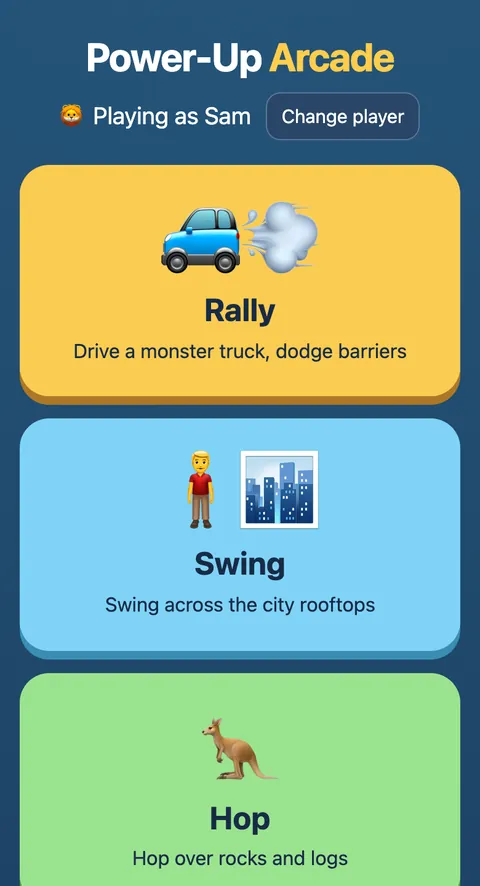
Rally, Swing, Penalty, Village Quests, Monster Maker and the rest: there are seventeen games, and “All the games share each player's practice, so questions come back when they're due in any of them”. For telling the time, the part worth having is the worksheet photo.
You take “a photo of a maths worksheet or homework page (1 or 2 pages)” and it will “make up to 15 practice questions that test the same thing with different numbers. You check them before your child plays.” The photo goes to Anthropic, the AI provider that writes the questions, and is deleted once read.
That is useful for the clock in particular, because the standards above move it along in narrow steps. A game that picks its own time questions can serve a five-minute question to a child who is still on half past, and one question like that can undo a lot of patience.
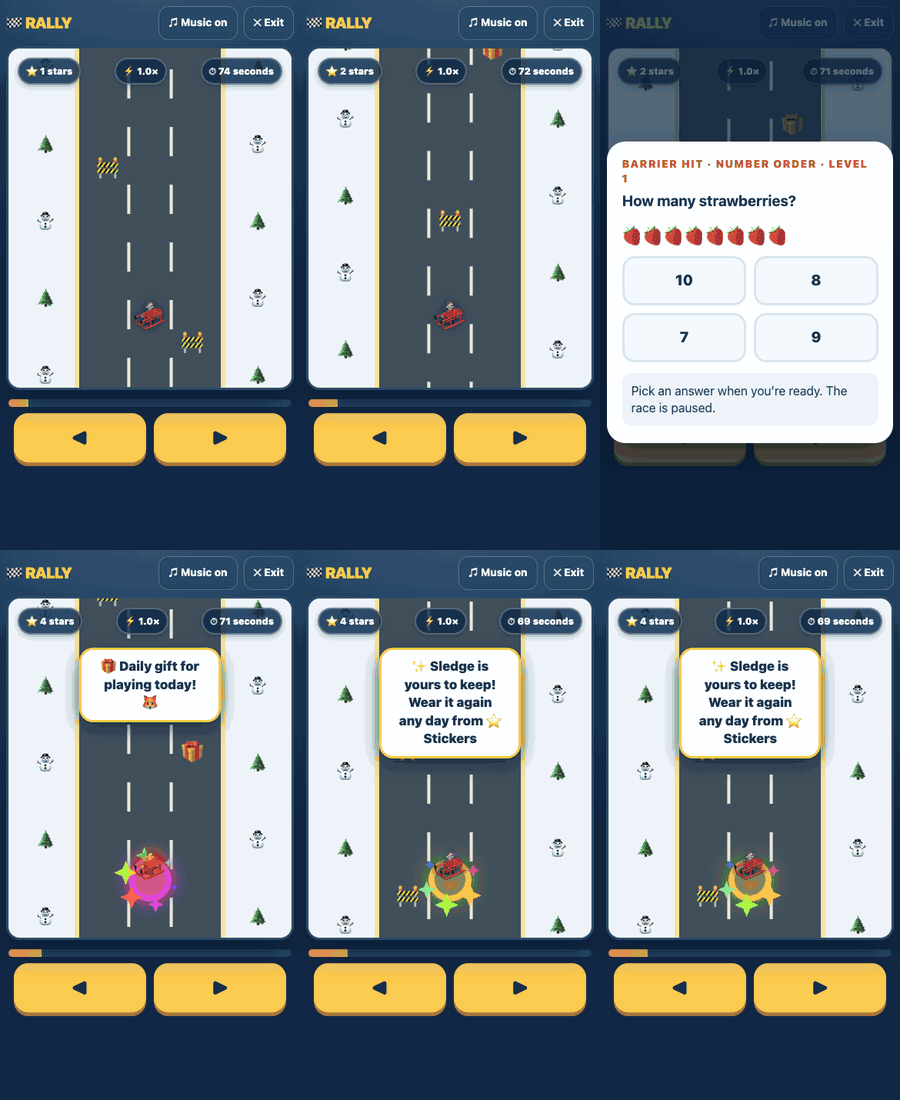
There is one more setting worth knowing about before you hand over a tablet. When a grown-up sets a goal with a reward on it, the counting is strict: “Only answers right first time count, starting now. Guessing until a button turns green doesn't move the bar.”
On the games page the free option is “a sample of 87 questions, saved on this device only”, which is enough evenings to see whether your child will sit with it.
When the clock is not really the problem
Sometimes the clock is not what is in the way.
The first thing to rule out is the fives. Skip counting by 5s to 60 is “the direct mathematical foundation for reading the minute hand”. Park the clock for a while, get the fives fluent, come back.
The second is a child who reads the on-screen clock perfectly and the wall clock not at all. Look at the minute markings. A clock face carries “60 small marks around the edge”, one for each minute, and Toy Theater's clock “features minute markers around the outside”. Check whether your own wall clock prints anything between the numbers. Make the jump deliberately: once they are fluent with the markings, switch to the wall clock and expect them to be slower again for a while. It is the same skill with the training wheels taken off, and worth saying so to your child, so the slowdown does not read as going backwards.
And if your child is well past the first-grade standard above and o'clock is still not reliable, raise it with the teacher, with the four steps running quietly at home alongside whatever they suggest. If you would rather start from the homework page than from a routine, see turn math homework into practice games and math practice games.
Frequently asked questions
At what age should a child be able to tell the time?
It arrives in stages, not all at once. The first-grade standard is “Tell and write time in hours and half-hours using analog and digital clocks”. The second-grade one is “Tell and write time from analog and digital clocks to the nearest five minutes, using a.m. and p.m.” The third-grade one is “Tell and write time to the nearest minute and measure time intervals in minutes”. So first grade asks for hours and half-hours.
What order should I teach telling the time in?
O'clock, then half past, then quarter past and quarter to, then the five-minute jumps. Give each step its own short goes, spread out, and stay on it until your child is faintly bored. The order matters because each step leans on the one before it, and the five-minute step also leans on the five times table.
Why does my child find quarter to harder than quarter past?
Because the two phrases point at different hours. A minute hand on the 3 means “quarter past the current hour”, and a minute hand on the 9 means “quarter to the next hour”. So “quarter to 8 means 15 minutes before 8. This is the same as 45 minutes past 7 or 07:45.” Say that out loud rather than letting your child work it out, then practice it with a question that needs the hour and nothing else, like whether the time is before or after dinner.
Should I teach digital or analog first?
Side by side. The first-grade standard names both: “Tell and write time in hours and half-hours using analog and digital clocks”. In practice the digital clock becomes your marking scheme. Your child reads the round clock, says an answer, then checks it against the digits. A tool that shows both at once does this for you.
Are the online clock tools good enough?
For setting a time and checking it, yes. Toy Theater's clock lets you move the hands, turn either hand off, and turn the digital clock on or off. Topmarks' Teaching Clock will show the current time, a random time, or any am or pm time you ask for, and it is listed for ages five to eleven. What they leave to you is holding the questions at the step your child is actually on, and remembering what they got wrong last week.
Can a game practice the clock worksheet my child brought home?
In the Power-Up Arcade you take “a photo of a maths worksheet or homework page (1 or 2 pages)” and it will “make up to 15 practice questions that test the same thing with different numbers. You check them before your child plays”. The photos go to Anthropic, the AI provider, and are deleted once read.
How long should we practice telling the time each day?
A few minutes, most days, beats a long session at the weekend. One real question at the wall clock plus a short go on a game is plenty, and it ends before anybody is annoyed, which is what buys you tomorrow's go. For the shape of a home practice session generally, see math practice games.